

Jensen Huang resigned on November 12, 2026, following a scandal that drew Nvidia, the world’s leading designer of GPUs and AI computing systems, and his private life into an espionage controversy. The contents of a classified policy memo prepared by Marco Rubio, drawing on but substantially recasting an earlier CIA assessment, were leaked to the press. The memo identified his affair partner, Alice Huang (no relation), as a suspected Chinese spy. The allegations prompted an Nvidia board investigation and ultimately Huang’s departure. Within days, senior figures across the intelligence community began qualifying the espionage claims.
The episode has an unexpected literary analogue in Edgar Allan Poe’s The Purloined Letter, which Jacques Lacan later read as a study of how a document acquires power through its circulation: who possesses it, who recognises its significance, and who remains blind to its passage.
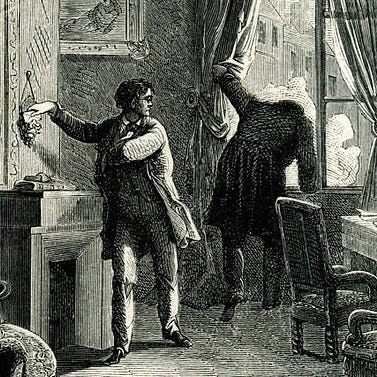
The affair raises a larger question. How did a modest CIA assessment become the basis for a more forceful memo, who controlled its circulation, and how did it reach the press? The answers open onto a struggle over American policy towards China, the future of the semiconductor industry and the growing influence of the national-security state over global commercial networks.
At stake are some of the foundational axioms of capitalism itself: the circulation of goods, capital, technology and information across markets; the continual expansion of exchange beyond national boundaries; the drive towards accumulation; and the tension between competitive markets and monopolistic concentration. The commercial interests that Huang represents depend on the expansion of these networks, while the national-security establishment increasingly seeks to organise them around geopolitical competition, strategic denial and state control.
The Nationalization Question
The idea of nationalizing AI entered mainstream debate in June 2026 from both sides of the political spectrum. Bernie Sanders introduced the American AI Sovereign Wealth Fund Act, proposing a 50% equity levy, paid in shares, on companies earning more than $200 million annually from AI. The proceeds would fund a $7 trillion public investment vehicle, paying an annual dividend to every American. Trump, speaking aboard Air Force One, discussed arrangements through which “pieces could be given to the American public,” making citizens partners in the companies themselves.
More consequential discussions were taking place inside the industry. Since early 2025, Sam Altman had been discussing government equity participation with the White House, and by July the Financial Times was reporting talks over a possible 5% government stake in OpenAI, valued at approximately $42.6 billion. These followed a pattern already visible elsewhere: a 9.9% government stake in Intel in August 2025; former NSA director Paul Nakasone’s appointment to OpenAI’s board; Hegseth’s threat to invoke the Defense Production Act against Anthropic during a contract dispute; and the Army’s recruitment of technology executives from Meta, Palantir and OpenAI into a new military detachment. The Atlantic described this emerging arrangement as “soft nationalization”: government influence exercised through equity, contracts, personnel and strategic partnerships.
These developments point towards increasing friction between capital and the state. Silicon Valley’s commercial success rests on the relatively free circulation of goods, capital, technology and talent through international markets and integrated supply chains. The national-security establishment is increasingly moving in the opposite direction, imposing strategic controls through export restrictions, sanctions, investment controls and supply-chain realignment.
The same tension runs through energy and commodity markets, where AI’s demand for plentiful, affordable power collides with sanctions and export restrictions that disrupt the flows on which expansion depends.
AI brings this conflict into particularly sharp focus. Advanced computing has become essential to military and intelligence operations, while access to leading models and semiconductors carries consequences for the global balance of power. In The Communist Manifesto, Marx described the business class breaking down national barriers, compelled by the need to extend its markets and establish connections across the world. His image of the Chinese walls falling before the advance of commerce acquires a particular irony today, as Washington erects barriers of its own. Trump’s trade measures, semiconductor export controls and investment restrictions seek to reorganise global production around strategic blocs, imposing geopolitical boundaries on the very circuits through which American technology companies have accumulated their wealth.
The nationalization debate therefore concerns less public ownership as such than the state’s growing role in determining the ownership, investment and organisation of strategic industries - and the conditions under which private capital can operate.
Foreign Factions
The Trump administration contains four competing centres of influence: China hawks around Marco Rubio, seeking to restrict Beijing’s access to advanced technology; Russia hawks, whose strongest base lies among Democrats and the Atlanticist establishment, committed to containing Moscow; Iran hawks concentrated in the Pentagon, AIPAC-controlled politicians and the national-security apparatus; and a commercial faction represented by Howard Lutnick, sections of the administration and executives such as Jensen Huang. Their priorities frequently collide. Trump’s attempt to draw Moscow away from Beijing through economic accommodation - the so-called reverse-Nixon strategy - runs against the Russian hawks’ commitment to sustaining pressure on Moscow and preserving the Atlantic alliance.
Huang’s position illustrates the commercial faction’s approach to technological dominance. He argued that restricting Nvidia’s chip sales to China would accelerate the development of a domestic Chinese semiconductor industry, eroding the American market position the embargo was intended to protect. Continued access would preserve Nvidia’s revenues and keep Chinese developers within an ecosystem built around American technology.
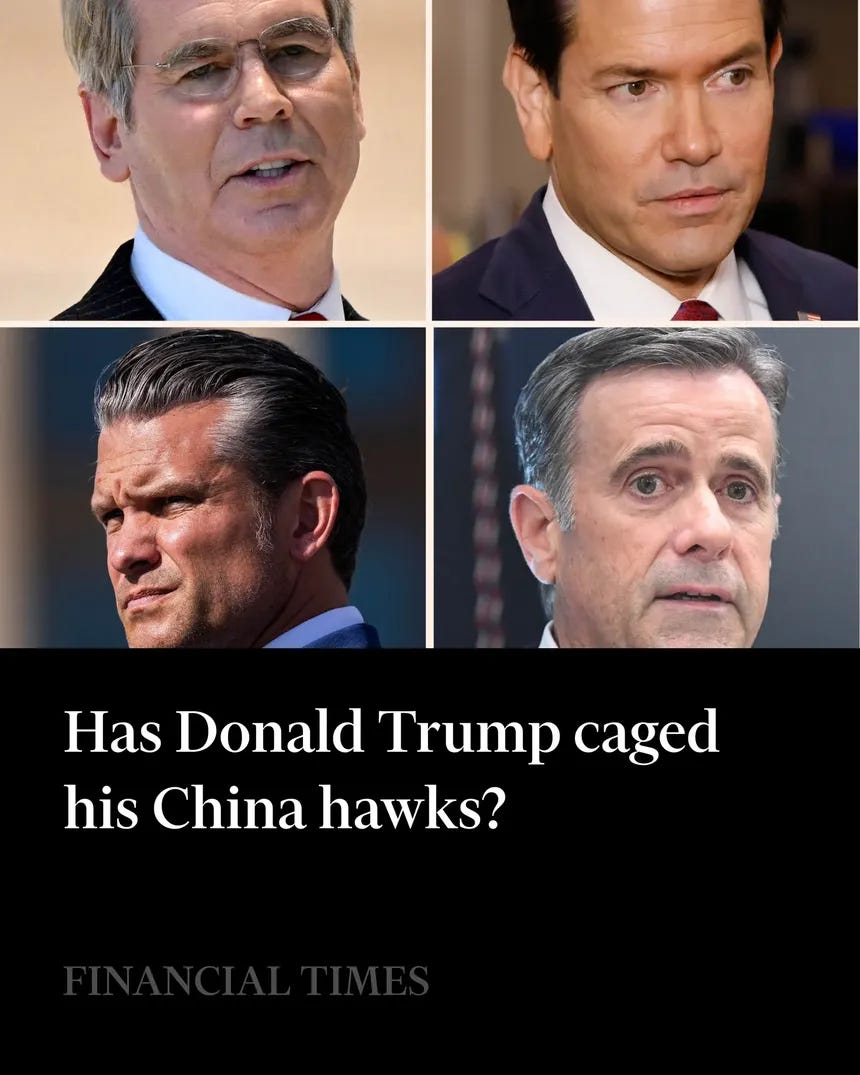
For much of 2026, the China hawks appeared to have lost ground. Foreign Policy described Rubio in May as Washington’s most articulate China hawk, while noting his limited role in shaping policy. The administration had approved Nvidia chip sales to China, reduced China-focused staffing at the Commerce Department and removed more than a dozen China specialists from the National Security Council. Rubio had adopted a softer vocabulary of cooperation and strategic stability. The China question receded as the Iran war absorbed the administration’s attention and Trump’s effort to draw Russia away from Beijing encountered resistance from those committed to containing Moscow.
Rubio’s memo brought China policy back to the centre of the debate. The Washington Post described the episode as a dramatic shift in power, reporting that Rubio’s intervention had helped set in motion the removal of one of the most influential corporate advocates of engagement with China. A former administration official offered a revealing explanation: “They wanted to destroy the influence Jensen had over the president.” The China hawks regarded Huang’s commercial strategy as a strategic liability, giving Beijing access to technology with potentially significant military and industrial applications. His departure consequently altered the balance of influence over a central question in American policy towards China, exposing the conflict between Nvidia’s global commercial interests and Washington’s growing emphasis on technological denial.
The timing adds another dimension. The memo was drafted in the spring, ahead of Trump’s visit to China. The first New York Times report appeared on October 29, five days before the midterm elections; further details emerged between November 6 and 8, after the Democrats had won both houses of Congress. The controversy then unfolded in the weeks before the planned Trump–Xi summit in Shenzhen. The sequence placed the allegations in a charged political window: after the midterms, as the administration prepared for a major diplomatic encounter with Beijing, and while the Iran war continued to dominate foreign policy.
Capitalism as the Anti-Market
Peter Thiel has observed that capitalism and competition are essentially opposites: the successful capitalist seeks a monopoly position from which to secure exceptional profits. Fernand Braudel provides a broader historical framework. In The Wheels of Commerce, he distinguishes the ordinary market economy, governed by competition and price mechanisms, from the capitalist anti-market: an upper sphere of concentrated power, privileged access and monopoly, where the greatest accumulations of capital take place. The capitalist seeks to shape the conditions under which markets operate, often through alliances with political authority.

Nvidia illustrates this dynamic in the AI economy. Its dominance rests on an integrated ecosystem extending from processors and CUDA software to networking and computing infrastructure. Amazon, Microsoft, Google and Meta are developing proprietary chips and vertically integrated systems to reduce their dependence on Nvidia and capture a larger share of the industry’s profits.
The AI industry is also divided over competing models of technological development: open-weight systems, such as DeepSeek, allow wider access to models and their adaptation, while leading American developers, including OpenAI and Anthropic, have largely pursued closed-weight, proprietary systems. Huang’s advocacy of open models follows a complementary commercial logic: wider adoption expands demand for the computing infrastructure Nvidia supplies. The contest over open and proprietary AI thus forms part of a wider struggle for control over the industry’s hardware, software, models and platforms.
The national-security establishment enters this struggle with its own instruments of concentration: export controls, investment restrictions, sanctions and strategic procurement. These measures shape access to technologies and markets, creating privileged positions for some companies while constraining others. State power increasingly determines the conditions of private accumulation, as corporations compete for influence within the system it creates.
The Memo’s Itinerary
There is something of The Purloined Letter in the journey of Rubio’s memo. Lacan was interested in the letter’s passage between hands, and in the changing positions of knowledge and blindness produced by its circulation. The memo followed a similarly consequential itinerary: from a CIA assessment into Rubio’s hands, through a restricted circle of senior officials, into the political apparatus governing technology exports, and eventually into the press. At each stage, its political function changed.
The Washington Post’s reporting of November 13 established the mechanics of Rubio’s intervention. He took a CIA report and wrote his own version, “recasting the agency’s reporting in his own more assertive terms.” A person familiar with the matter told the Post that its language was “far more forceful and assertive than the original.” Drafted in the spring and circulated among senior officials before Trump’s May visit to Beijing, the memo was passed to Howard Lutnick at Commerce, who oversees the export-control apparatus at the centre of the dispute. Rubio also briefed the president. He exercised considerable influence over the document’s wording, circulation and readership. The identity of the person who subsequently leaked it to the New York Times remains unknown. David Sacks drew attention to this on X on November 13:
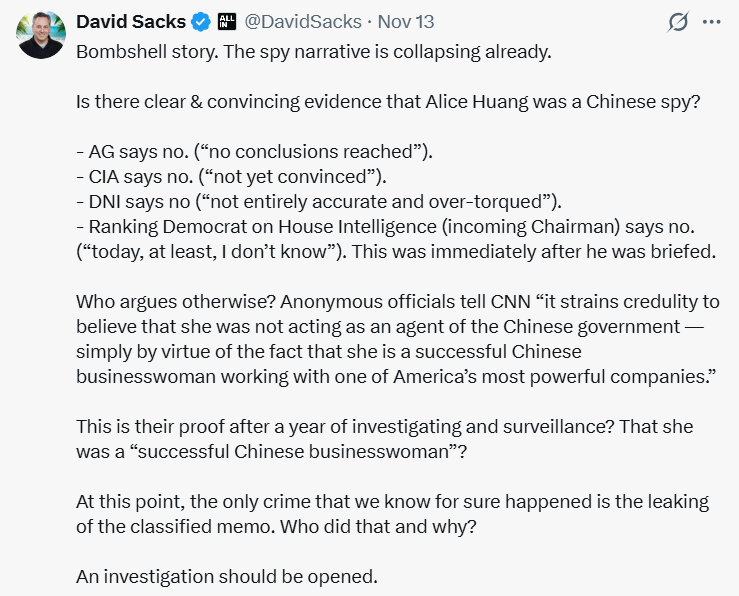
The subsequent walk-back makes the leak’s origins all the more significant. Within seventy-two hours of Huang’s resignation, senior figures across the intelligence and political establishment had begun qualifying the espionage allegations. At a November 12 press conference, a spokesperson said the question “assumes something I have never said and that I don’t know to be true.” The CIA was “not yet convinced” that intercepted communications showed Alice Huang knowingly funnelling information to Beijing; Office of the Director of National Intelligence officials described the characterization as “not entirely accurate and over-torqued.” Trump himself said, “I don’t know if that’s been determined yet.” The allegations that precipitated Huang’s departure were thus losing their certainty within the institutions responsible for assessing them.
The distinction between the original intelligence and Rubio’s version remains central. Rubio’s memo reportedly asserted recruitment by China’s Ministry of State Security, active espionage and a national-security emergency in language considerably more forceful than the underlying CIA assessment. The evidence establishes that Rubio recast the intelligence and that the document was subsequently leaked.
Whether he anticipated or intended that outcome remains unresolved. The episode nevertheless had a clear political effect: a classified document carrying the authority of intelligence brought the China hawks’ agenda back to the centre of debate, placed Huang under immediate pressure and returned semiconductor exports to the national-security agenda. A dispute over commercial access to China had become a public scandal over espionage and personal conduct, shifting the balance of influence inside the administration.
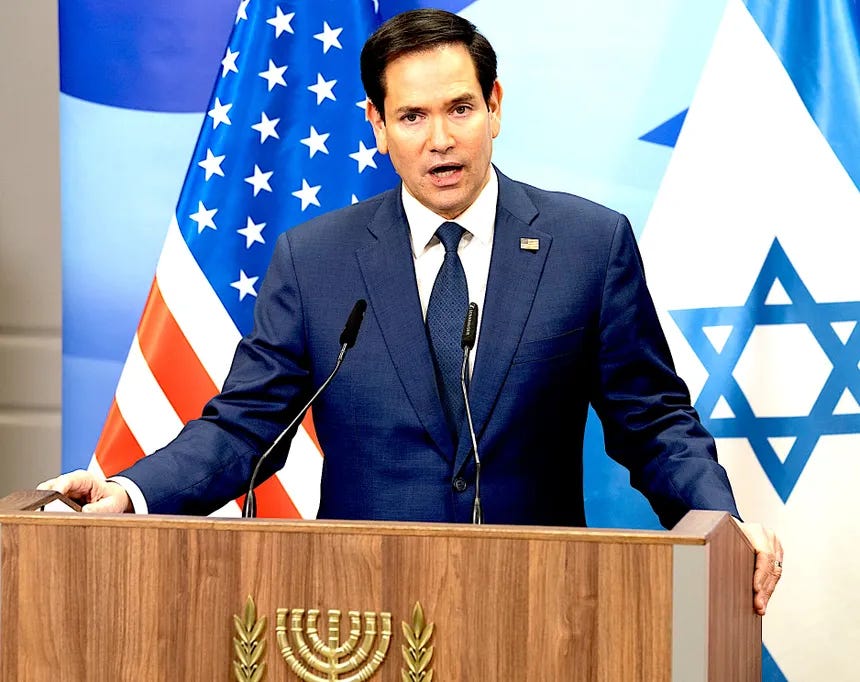
There is an irony here for Rubio himself. He has been the subject of unsubstantiated rumours about his sexual orientation. Yet an administration willing to turn allegations about personal vulnerability into political weapons invites the same scrutiny of its own ranks. Those who live by insinuation may find themselves judged by the same standard.
In Lacan’s reading of Poe, a letter always arrives at its destination, although that destination may only become apparent through the consequences of its circulation. Rubio’s memo followed a similar course. Its origins and the intentions behind its release remain obscure, yet its passage through Washington and into the public arena has altered the balance of influence over American policy towards China.
The immediate casualty may have been Huang, and the immediate beneficiary Rubio. Yet the larger target may have been Trump himself, whose freedom to manoeuvre ahead of the Trump–Xi summit could be constrained by a document circulating through the very administration he commands.
Missed you!
You’re away because you’re confused I guess?
Write about that, share with us sir!