
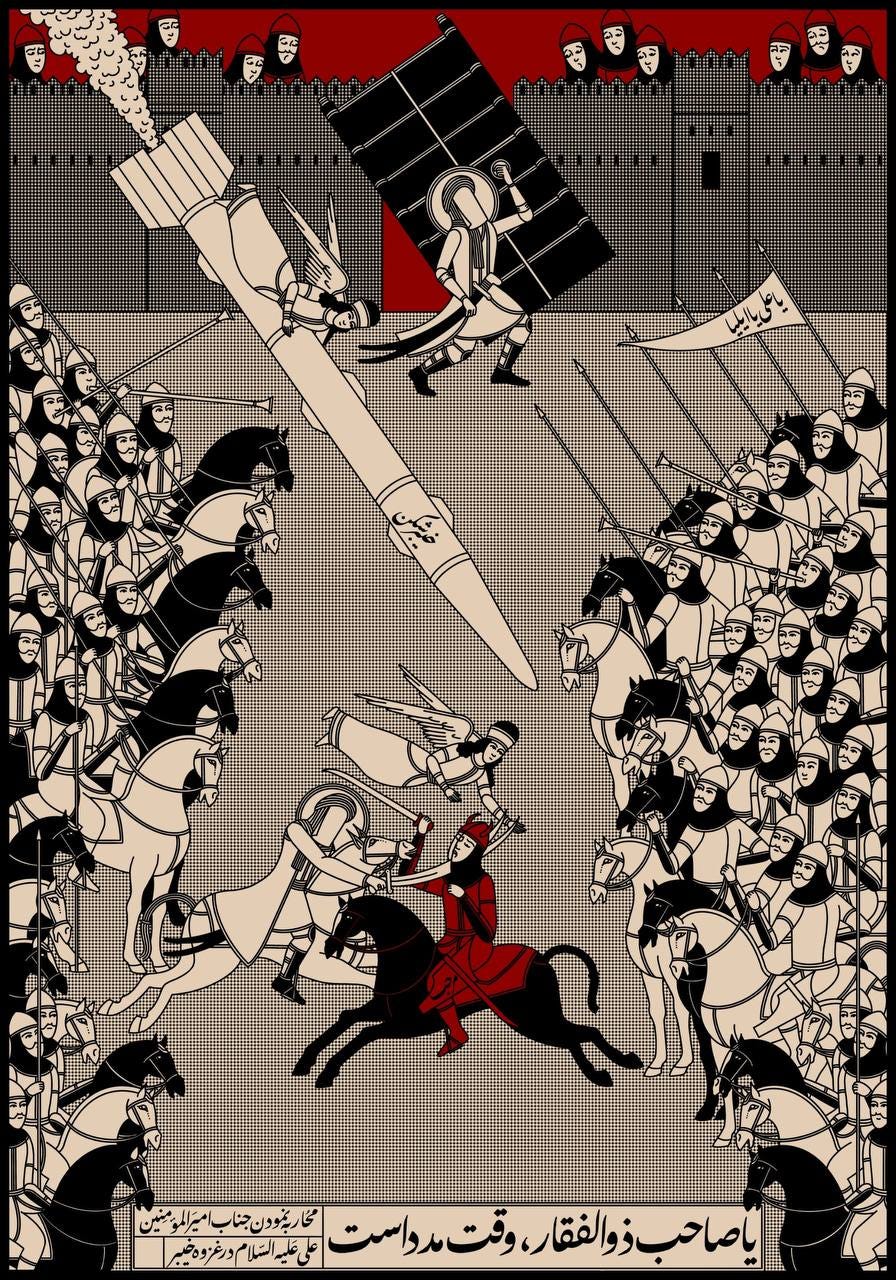
Note: This article launches a collaborative series with Pio Torroja – my fellow architect, author and friend from Argentina. The Spanish edition of this article will appear on his Substack. Please subscribe.
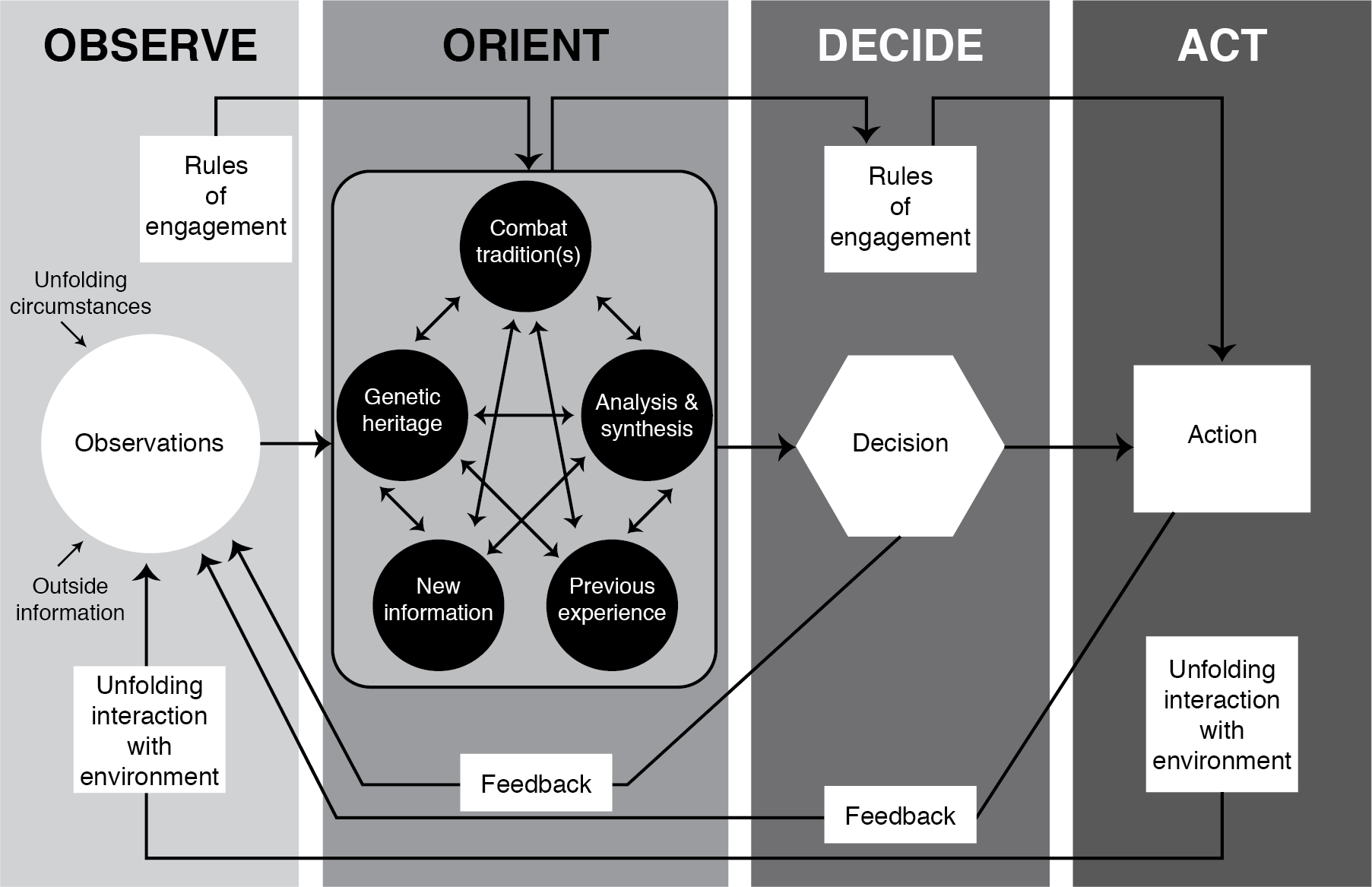
Wars are fought with more than weapons and soldiers. A society's cultural unconscious – its sense of time, its concept of authority – shapes how it fights. US Air Force Colonel John Boyd's OODA loop – Observe, Orient, Decide, Act – places cultural orientation at the crux of decision‑making.
Boyd derived the loop from one‑on‑one fighter pilot engagements: the pilot who cycles faster gains a decisive advantage by getting inside the opponent's loop. The Orientation stage turns the decision‑maker both inward and outward: he must know his own tendencies without self‑deception, and master the adversary's cultural impulses without contempt.
The deepest currents of Iran’s cultural orientation lie in Twelver Shiism. This tradition centres on a distinctive eschatological structure – a doctrine of last things and ultimate redemption – known as the Occultation (concealment) of the Twelfth Imam. Within it, absence acquires efficacy, and dispersal becomes a condition of persistence. These same elements reappear in Iran’s mosaic military doctrine, where command distributes across self-sufficient units and operational continuity survives without a visible centre.
The ongoing Iran War has activated this mosaic structure. An unprovoked Israeli airstrike murdered Supreme Leader Ayatollah Ali Khamenei, forcing the Iranian military system to choose between collapse without a fixed leader or survival through dispersion. In the event, authority redistributed across provincial commands, and retaliation emerged through multiple milieus. The conflict settled into a lingering, fragmented pattern resistant to centralised resolution. A theological structure of occultation found expression in military form.
Where Boyd's OODA loop assumed a single opponent whose decision cycle could be disrupted, Iran's mosaic doctrine follows the logic of the Hydra, the mythical serpent that regenerated several heads for every one struck off: decapitation multiplies autonomous decision centres. The United States and Israel must now manage a mosaic of OODA loops at once. Boyd's original model never foresaw this eventuality.
The Iran War thus unfolds across competing temporal and metaphysical horizons. For Iran, the mosaic doctrine favours survival; the clock favours the patient. The Twelver structure organises time around concealment and return, shaping expectation around a hidden presence that acts without appearing.
For Israel and the United States, by contrast, Third Temple Judaism and dispensationalist Christian Zionism frame events as a race toward salvation. Victory means imposing their law on their enemies – and it must happen now. Underlying the American and Israeli orientations is the Mosaic covenant – a transcendent law that assembles shattered tablets into wholeness, demanding commandment and obedience.
From these three eschatological layers emerges a deeper question of organisation: how authority under threat endures by dispersing across a milieu. These horizons of last things subtly pull at a society's unconscious, moulding orientation before the first observation.
Two Occultations
Twelver Shiism locates spiritual and political authority in a lineage of twelve Imams descended from the Prophet Muhammad. The eleventh Imam, Hasan al-Askari, was murdered, Shiite tradition holds, by the Abbasid caliphate in 874 in Samarra. He left a young son, Abu al-Qasim Muhammad, who became the Twelfth Imam. This is the Mahdi, the guided one destined to return as the eschatological redeemer who will establish universal justice.
The Abbasids were hunting the boy. A living Imam, even a child, represented a rival centre of legitimacy – a direct challenge to Abbasid rule. He could not stay in the open. Under immediate threat, the child vanished from public view shortly after his father's death.
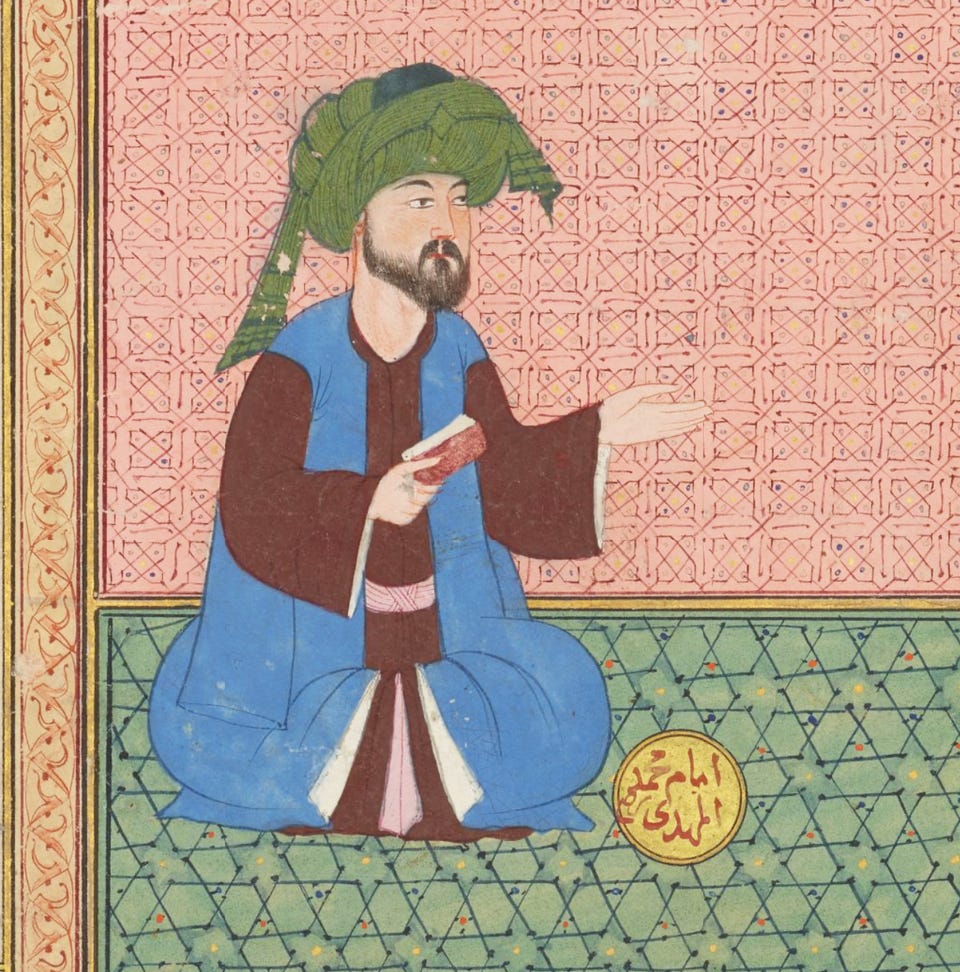
This concealment unfolded in two phases. The Minor Occultation (874–941) preserved a mediated presence. The hidden Imam communicated through four deputies, who transmitted his rulings and maintained institutional continuity. The community had points of contact with the hidden Imam – his deputies – albeit indirect, since the Imam himself remained invisible. Authority persisted through trusted intermediaries.
The Major Occultation (941 to the present) marked a deeper transformation. The line of deputies ended, and the Imam ceased all direct communication. By then the boy would have been over seventy years old. Twelver tradition, however, does not reckon by ordinary time. The Mahdi lives – hidden from human perception – while the faithful await his return at the end of time.
During this long concealment, authority entered a distributed condition, circulating through juridical interpretation and ritual practice, anchored in collective expectation. The Imam's presence seeped into everything, fixing nowhere.

His return will be preceded by signs: widespread injustice and the rise of false prophets. Two figures will appear: the Sufyani, a tyrant from the Levant (present‑day Israel, Palestine Lebanon and Syria), and the Yamani, a righteous leader from Yemen. Their appearance will trigger a cataclysmic shift. Then the Mahdi will emerge from concealment, and justice will flood the earth.
Transcendence and Immanence
Every religious tradition must manage the tension between transcendence and immanence – between a power that is beyond and above, and a presence that is distributed and within. In Islam, Allah is purely transcendent – as is God in Judaism and Christianity. How can such a distant authority shape immediate affairs?
Christianity answers with the Holy Spirit, dwelling within the community and individual believers. Judaism turns to the Shekhinah, the indwelling presence that accompanies the people even in exile. In Twelver Shiism, the hidden Imam – the Mahdi – remains a singular, hidden figure, yet his authority circulates immanently.
A society that concentrates authority in a single visible centre – a king or a dictator – follows a logic of transcendence. A society that disperses authority across a field – tribes or mobs – follows a logic of immanence. The same theological structures recur in earthly power.
Shiism offers a distinctive case. Its theological solution – an absent source operating through distributed presence – contains a political logic uniquely suited to minority existence under hostile Sunni‑majority rule. Concealment became second nature. Patience meant survival. Deferred fulfilment became a structure of hope. The absence of a visible sovereign reorganised authority across a field of relations sustained by belief and law.
The 1979 Iranian Revolution tilted the balance decisively toward transcendence – but with a twist of immanence. During the Major Occultation, the Imam existed only in the metaphysical realm. Temporal authority passed to a college of religious scholars – the ulama – who interpreted divine law in his absence. Ayatollah Khomeini broke with this tradition. He did something bold, possibly heretical: the crowds acclaimed him Imam spontaneously, and he accepted a title reserved for the twelve infallible descendants of the Prophet. At the same time, his doctrine of velayat-e faqih (guardianship of the jurist) defined the Supreme Leader as the political deputy of the hidden Imam. Khomeini thus ruled on earth as Imam (by popular acclamation) and in the metaphysical realm as deputy of the hidden Imam (by theological tradition).
Drawing on the strong executive model of the French Fifth Republic, Khomeini armed Iranian society with a powerful, visible leader. The hidden Imam remained the cosmic sovereign, responsible for ultimate redemption. The visible Imam – the Supreme Leader – now ran the earthly domains of politics, war, and law. Earthly authority tilted decisively toward transcendence. The immanent field withdrew into the background, waiting for a shock to reactivate it.
The Israeli‑American surprise attack on Iran triggered a reconfiguration of this pattern. Following the death of Imam Ali Khamenei, his son and successor, Mojtaba Khamenei – under constant threat of Israeli assassination attempts – entered a condition of concealment, governing through intermediaries while remaining physically inaccessible. The structure of the Minor Occultation reappeared within a modern wartime context. Authority persisted through mediated absence. Once again, the transcendent source – the office of Imam/Supreme Leader, now hidden – operated immanently through deputies and distributed nodes. The pattern transduced across historical scales, finding new flesh for an old structure.
How does an absent or hidden centre continue to produce coordinated effects? How can a structure maintain coherence when its originating authority withdraws from direct presence? In theological terms, this is the problem of transcendence seeking immanence. In political and military terms, it is the problem of bottom‑up coherence without top‑down command. Answering these questions requires a more general account of how structures emerge and transform.
Simondon’s Philosophy of Individuation
Gilbert Simondon (1924–1989) operated at the rift between philosophy and the sciences. Trained in philosophy, he engaged theoretical problems with the sensibility of an engineer. He taught at the Sorbonne and later at Paris V, grounding his philosophy in concrete processes – a crystal forming, a cell dividing, a machine regulating – rather than in abstract categories. His project unfolded across two registers: an ontology of individuation – a study of how beings take shape within charged fields of potential – and a theory of technical objects, understood as evolving structures with their own internal coherence.
During his lifetime, Simondon's work remained in relative obscurity. Gilles Deleuze drew on concepts such as the preindividual, metastability, and transduction, carrying them into a broader philosophical scene – an eclipse in which Deleuze's flamboyant spectacle blocked Simondon from view. Yet Simondon's light still radiated around the edges. A generation of philosophers, tracing Deleuze's sources, returned to Simondon's original writings and lifted his ideas from the shadows. Artists, architects, and technologists, grappling with the nature of creativity, found in Simondon's work a new resonance.
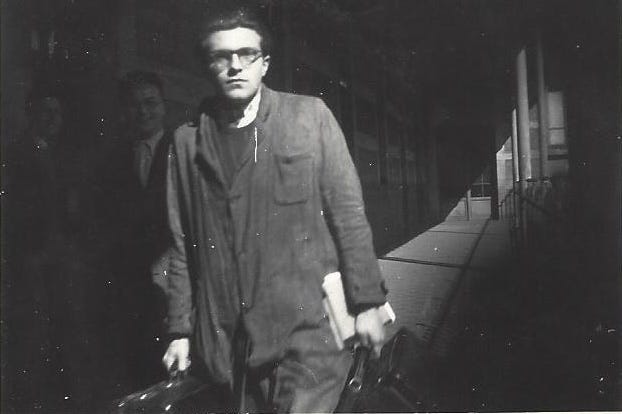
A single question propelled Simondon: how does an individual emerge? Earlier ontologies sought to understand individuation by starting from the individual – as if the individual were the primary reality. Simondon begins with the process. An individual is a provisional yet coherent resolution of tensions within a milieu of relations.
At the centre of his thought lies a simple shift: individuals arise from prior fields of potential, charged with tensions – disparities – that have yet to resolve. He names this domain the preindividual. It exists in a metastable condition, where multiple pathways remain open. Individuation unfolds as these tensions find partial resolution, giving rise to structured beings while preserving a reserve for further transformation.
This inversion is fundamental. Simondon distinguishes between being‑as‑such and being‑as‑individual. Being‑as‑such is the preindividual field itself – the reservoir of tensions and potentials that never fully resolves into any single form. Being‑as‑individual is the provisional shape that emerges from that field, never exhausting it.
For any person, being‑as‑such is the genetic inheritance, the childhood wounds, the language learned at home, the humiliations and triumphs that never fully settle. Being‑as‑individual is the name, the face, the CV, the public persona. The field never empties itself into the individual. The person carries unresolved tensions, dormant potentials, capacities for change. Individuation has no endpoint short of death.
Simondon’s Information
An example of metastability is when a snowpack accumulates layer upon layer, building internal stresses while appearing stable. A trigger – an errant skier, a launched explosive charge – can release these stresses in an avalanche. This temporary resolution arises from the snowpack’s own internal condition, not necessarily from the trigger’s magnitude. Simondon calls this triggering operation information – the bringing‑into‑form of a latent structure within a metastable field.
Information in the Simondonian sense arises from the encounter between a trigger -which Simondon calls a germ – and a metastable field. It acts as a catalytic event, provoking the field to resolve some of its own latent disparities – tensions lying dormant. Individuation proceeds through successive local resolutions, each stabilising part of the field while preserving further potential.
When Structure Dissolves
The same process that shapes a single person also propagates across populations, linking individuals into shared structures. Simondon calls this propagation transduction – the stepwise spread of structure across a domain. The process of crystallisation demonstrates the logic. In a supersaturated solution, the liquid strains to hold more than it can bear. A tiny disturbance – a speck of dust – and a crystal nucleus forms. That nucleus then modifies local concentration and temperature, allowing each new layer to form under slightly different conditions. The resulting crystal is continuous but historically layered: each layer carries the trace of its own formation. No two layers are identical, yet the whole coheres.
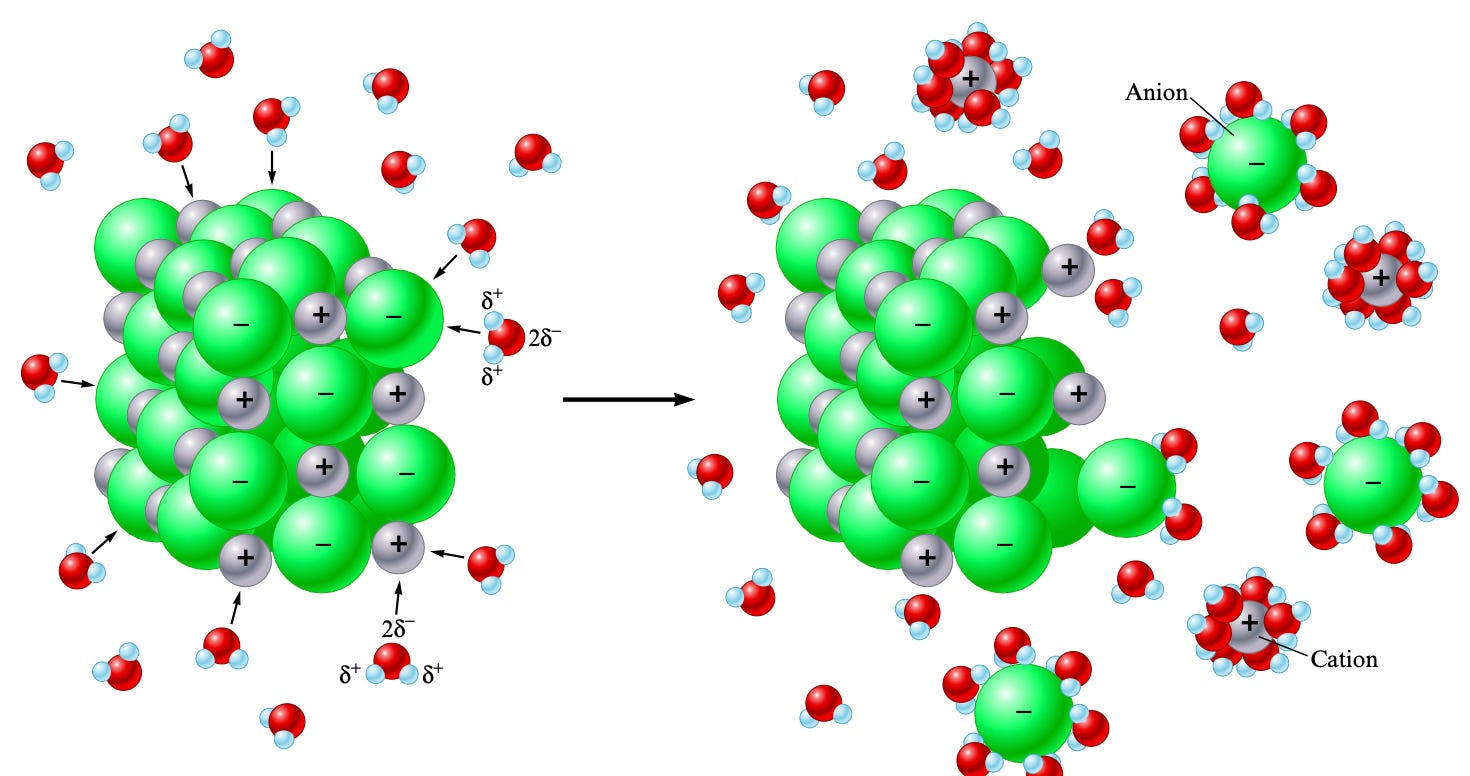
Structure can also dissolve. A crystal does not last forever. Drop it into a solvent, and its organised form releases back into the solution, redistributing tensions and renewing the system’s potential for future formations. Alongside individuation, a complementary movement becomes necessary. We introduce the term ontolysis for this movement – from the Greek lysis (dissolution) and onto‑ (being). Simondon himself did not use this word; it extends his vocabulary. Through ontolysis, a formed structure re‑enters a metastable condition, altering the field from which new individuations can arise. What crystallises can later dissolve. What dissolves prepares the ground for new crystallizations.
The Transindividual Domain
How do preindividual potentials circulate within groups? Simondon’s answer is the transindividual domain. It operates as a double movement: the individual interiorises collective potentials, and the collective emerges from the individuation of individuals. Neither pole precedes the other. The individual psyche and the social group are co‑constitutive, bound by reciprocal coupling.
Individuation requires more than the absorption of collective potentials. The individual must also withdraw from the collective to confront the preindividual field alone. Simondon calls this necessary withdrawal an ordeal of solitude. The ordeal of solitude is the dynamic link between the transindividual and the preindividual. It is the moment when the individual, having interiorised collective potentials, withdraws to confront the raw, unresolved field of potentials alone. Without this tethering, the individual would remain stuck in the collective – mere social conformity – or lost in the preindividual – dissolution without return. The ordeal of solitude is the oscillatory movement between the two. It is a form of ontolysis at the scale of the psyche: structured relations dissolve, the familiar social world recedes, and authority circulates through absence.
Twelver Shiism via Simondon
Simondon never wrote about Islam; extending his framework to Twelver Shiism carries his concepts into unfamiliar territory. Authority redistributed from a localised individual (the hidden Imam) into a transindividual field – the community of believers, the juridical tradition, the collective practice of waiting. That field persists across centuries, sustaining coherence through dispersed relations without any central authority. The hidden Imam remains a singular figure, but his authority now circulates through the field. He becomes the metaphysical transcendent – a source beyond reach, present only through absence.
The Major Occultation of the Twelfth Imam is such an ordeal at the scale of a community. The Imam withdraws; authority dissolves into the field of believers, juridical tradition, and collective waiting – ontolysis at a civilisational scale. Yet the transindividual domain sustains coherence without a visible command point. Shared affect and ritual keep the field charged. This same logic appears in Iran’s mosaic doctrine: a distributed network acts as one through the field. Coherence is a property of the field itself, not of any command centre.
Khomeini’s doctrine of velayat-e faqih appears as a renewed individuation within this same field. After centuries of circulation, authority crystallises again – but not by his will alone. The title of Imam arrived as a spontaneous popular bestowal, a transindividual movement received with diligence by both society and Khomeini. He gathered distributed potentials into a new institutional form, the Supreme Leader, who operates in the earthly realm. Khomeini grounded transcendence in a visible, powerful leader, modulating popular acclamation into political form. The crystallisation remains connected to the broader transindividual medium, drawing legitimacy from the field it condensed from. Two forms of transcendence now coexist: the hidden Imam’s metaphysical absence and the visible Imam / Supreme Leader’s worldly presence.
The problem of hidden authority thus becomes intelligible as a question of field dynamics. Structures persist through ontogenesis (the emergence of structure), ontolysis (its dissolution), and the continuous play of information and transduction between them. Presence and absence enter into a metastable relation, mediated by the field’s own tensions. An absent centre opens a space between. That space fills with tension and circulation. Authority moves through the intervals; the field lives in the between.
Two Metaphysical Orientations
Superior orientation is the key to victory – but it requires a double movement: knowing yourself and knowing your enemy. Strategic observations pass through your own cultural mesh; they must also be tempered by your adversary's deepest inclinations.
A society’s orientation tilts one of two ways: towards transcendence or immanence.
Transcendence relies on a visible centre of authority. Sever that head, and the system dies. The Western Mosaic covenant operates on this logic.
Iran’s mosaic doctrine works otherwise. It disperses capability across a field of semi-autonomous units. Authority flows through the system. Not losing is the road to victory. Absence becomes operative: coherence never settles anywhere, but responses are always somewhere.
Iran's strategists learned the value of dispersion by watching their enemy's collapse.
Saddam’s Fall
Saddam Hussein’s Iraq lodged authority in a single visible centre – a pure case of political transcendence. Sever that head, and the system collapses. When the US invasion decapitated Saddam’s regime in 2003, it lost its organising principle and fragmented.
From the rubble of the Ba'athist collapse, a new orientation emerged: Sunni insurgent formations working through dispersion. Independent cells achieved adaptive coordination across shifting terrain. Coherence took shape from within, not from above. Even under the following years of sustained American pressure, this distributed form proved stubbornly persistent. Immanence proved itself in practice; Iranian strategists turned it into theory.
The underlying pattern – distributed authority – had long been latent in Iran's own civilian institutions, submerged beneath Khomeini's transcendence‑leaning system. The military, with its three overlapping layers – regular army, Revolutionary Guard, and Basij volunteers – exemplifies the same logic. What reads as bureaucratic redundancy is in fact a metastable field – immanence held in reserve, waiting for the shock that would reactivate it.
Iran’s Mosaic Doctrine on the Battlefield
Iran's mosaic doctrine transforms Boyd's problem. His OODA loop presumed a contest between relatively unified decision cycles. Iran's mosaic multiplies those cycles across the field. Each node runs its own OODA loop at its own tempo. Hydra heads multiply: decapitate at one point, and activity springs up at many others. Orientation toward a single adversary now meets a field of distributed responses.
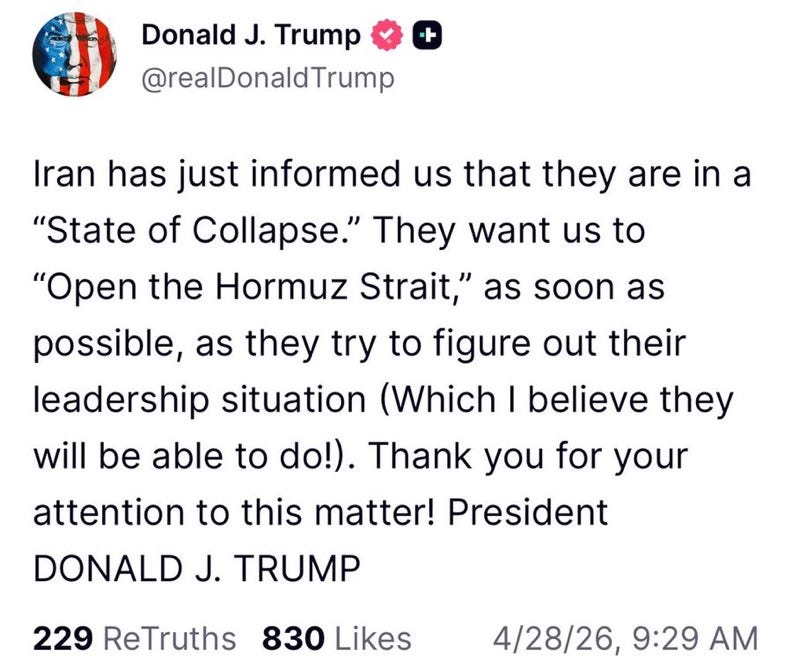
The American president – whose political persona exemplifies the transcendence regime – sees only dysfunction. The very features that guarantee the mosaic's resilience – an apparently absent leader, authority scattered across autonomous nodes – register with him as failure. He mistakes Iranian ontolysis for chaos – a failure born of self‑deception about the weaknesses of his own system and contempt for his adversary's.
The war is stuck in the limbo of hesitant negotiations, but Iran needs no unified front. America's "agreement incapability" has become a cliché. Talks with the US and Israel are often simply a gambit to corral enemy quarry for strikes – the elder Khamenei and his leadership council were killed while discussing US negotiation terms. Trump's call for Iranian leadership unity could just as well be a gambit to get them to gather again under one roof, leading to yet another decapitation strike.
With no deal on the horizon, the war has now settled into duelling sieges: Iran chokes the Strait of Hormuz, blockading the global economy; the US replies by blockading Iranian shipping. Historically, the rougher, readier side outlasts the rich and pampered. If serious American proposals were ever to arrive, Iran could pivot quietly away from immanence and absence back toward transcendence and presence.
Mosaic Multipolarity
Mosaic warfare is a microcosm of the emerging multipolar order. The same structural features recur – distributed centres of power, overlapping spheres of influence, a persistent lack of single command – but now at the global scale. Each state or bloc acts as a partially individuated unit within a broader transindividual field. Their interactions produce ongoing adjustment and reconfiguration. Global coherence persists without a hegemon, sustained by the dynamic interplay of its components.
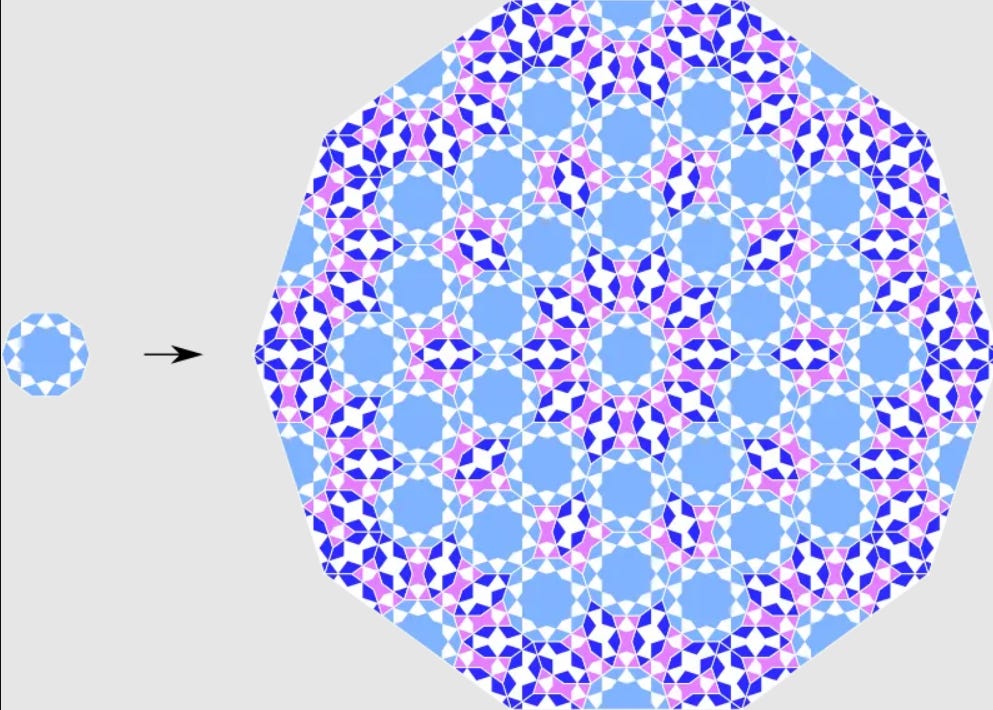
The Iranian mosaic doctrine is a smaller instantiation of the same pattern. The logic of dispersion, circulation, and metastability repeats across levels – from IRGC tactical units to regional alignments like BRICS to the emerging multipolar constellation. The underlying structure of immanence remains legible throughout.
The theological solution of the Major Occultation – a hidden centre effective through distributed circulation – has become the strategic reality of the twenty‑first century. To fight such a system on the battlefield is to engage a field with no single evil doer to decapitate. To confront it globally is to face a world where no external will can dictate universal outcomes.
The Iranian mosaic has so far survived decapitation and is systematically shattering the Mosaic worldview's tablets. The detritus of unipolarity is reconfiguring as a field of distributed authority – a multipolar mosaic whose cohesion arises from the interstitial tensions between its fragments.
Very interesting. I’ve been meaning to read Simondon since I came across him through Deleuze (a connection you acknowledge) during my PhD studies.
“Transcendence relies on a visible centre of authority. Sever that head, and the system dies. The Western Mosaic covenant operates on this logic.”
This is different from my understanding of the transcendence/immanence pairing (indeed as you say, not an opposition). I follow Deleuze that all is immanence and what we regard as transcendence is in its arrangement or assemblage into something seemingly unreachable. Taken to the political, the transcendent would be unassailable. (No opportunity to change Christ’s divinity, to take the most extreme example, so Christianity lives on.) But if we regard all as immanent then micro-organisms of growing resistance, for example, can possibly modify or upset that idea.
A mistake the left makes is in regarding Trump as immanent, assailable (if only we could get more public support), an individual subject, whereas the problem may be that Trumpism is a name and a power that at this point might be transcendent and unassailable.
It’s more likely though that Trump’s power is “transcendental,” in the Deleuzian adoption of Kant, as empirically everywhere all at once, which is closer perhaps to the immanence you describe. Indeed Deleuze puts them together as “transcendental empiricism.”
Great commentary as always. I wonder, do you think Simondon has something to say about the subject of consciousness? It’s a problem I’ve been working on lately.
Hello Kevin, very interesting article, yet one, my complimente! I love the way you compared the US/Israeli “Mosaic covenant” with Iran’s Mosaic structure ; very well seen: the same word but through completely different cultural and religious lenses.
** You write “forcing the Iranian military system to choose between collapse without a fixed leader or survival through dispersion” : but was the choice so really binary ? I am just wondering whether the Mosaic structure is really implemented or whether only partially. You also admit later on in the article that it is indeed "semi-independence" only. Because obviously when there is also a diplomatic dance going on, any wrong move by independent actors in Iran may well kill the “deal”, assuming it could be favorable to Iran. At least one assumes that the Iranians believe a deal could be potentially favorable to them, otherwise they wouldn’t be negotiating and that presupposes careful Clausewitzean coordination at the top between the IRGC, army and the other civilian administrations of government that are concerned. Iran is still acting as a state agent internationally, not only towards its adversaries but also towards its allies – this in itself forces Iran to not deploy a complete mosaic structure, but only go further towards immanence than Western nations can possibly understand.
** Interesting connection between “Minor Occultation” and the current Khamenei the younger. It feels so alien to the Western powers attacking Iran, but must feel much more natural for Iranians.
** From a political point of view, the distinction you make between Immanence and Transcendence is very interesting. There is probably more to say there using this lens to look at politics.
The last part of the essay is also very interesting, and Simondon reminds me a lot of Ortega y Gasset, and his concept of “proyecto vital”. He famously said : “Yo soy yo y mi circunstancia”, which very much recalls Simondon’s process. There is no known connection between the two others though, but Simondon must have know the Spaniard, of course.
Finally, you write about the Trump transcendent regime’s failure to see the immanence of Iran but remember that the US, with its “check and balances” and its “separation of powers”, has an immanence built into it constitutionally upon foundation, though it may not be so natural for this Anglosaxon culture. I will probably use this insight in one of my next articles on the character of the United States. I will cite this article of course. :)