
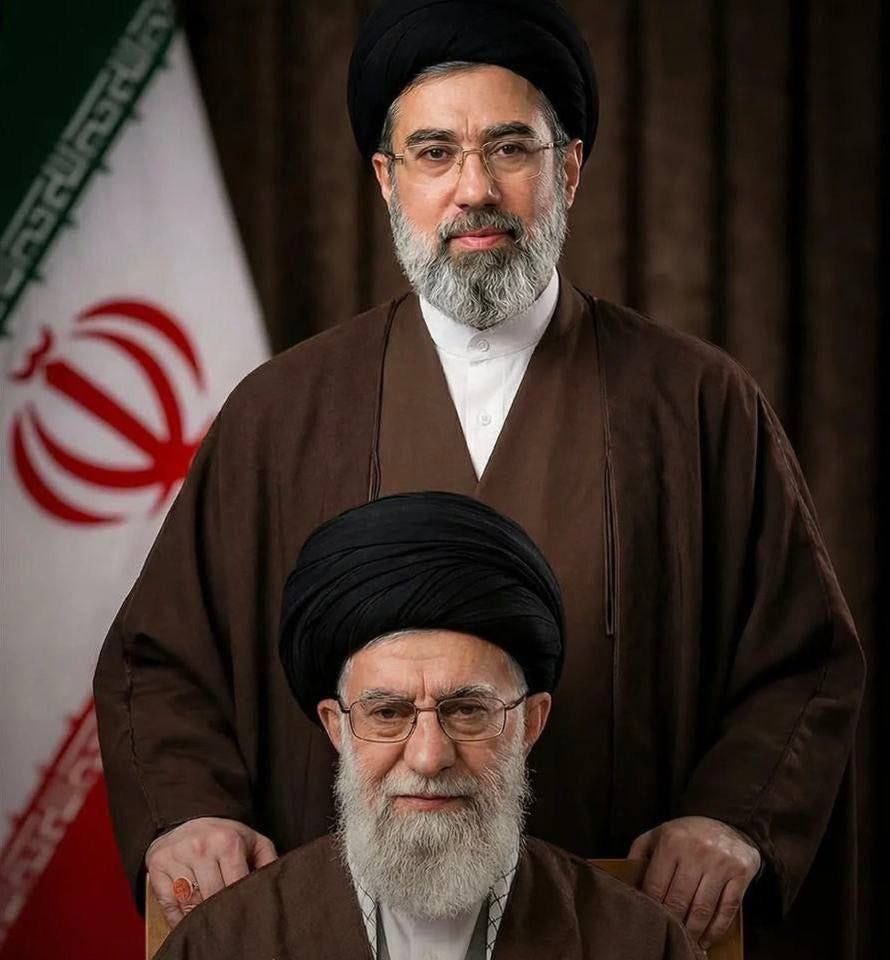
As Iranian state media announced that the son of Ayatollah Khamenei had been named to succeed his father, it became clear that the decapitation strike that killed Iran’s Supreme Leader has spawned something far more dangerous than the man it removed. The son who now assumes power lost his parents, his wife, and two of his children in the American and Israeli attack. His more “liberal” father who negotiated with Obama, who reopened talks with Trump in 2026 despite Israel’s 2025 Twelve-Day War betrayal, who publicly forbade nuclear weapons and kept Chinese and Russian influence at arm’s length—that father is dead. His son inherits not only his position but the memory of his humiliation and the obligation to avenge it.
Sigmund Freud derived the concept of the Oedipus complex partly from his own childhood. He recalled his father Jacob walking in the street when a gentile knocked his new fur cap into the mud and shouted, “Jew, get off the pavement!” When young Sigmund asked what his father did, Jacob replied, “I went into the roadway and picked up my cap.” The future founder of psychoanalysis was devastated. His father had accepted insult without resistance. He had displayed weakness rather than strength. This moment planted the seed for Freud’s later theory: the son must surpass the father, must become what the father failed to be, must restore the family name through his own more aggressive assertion of power.
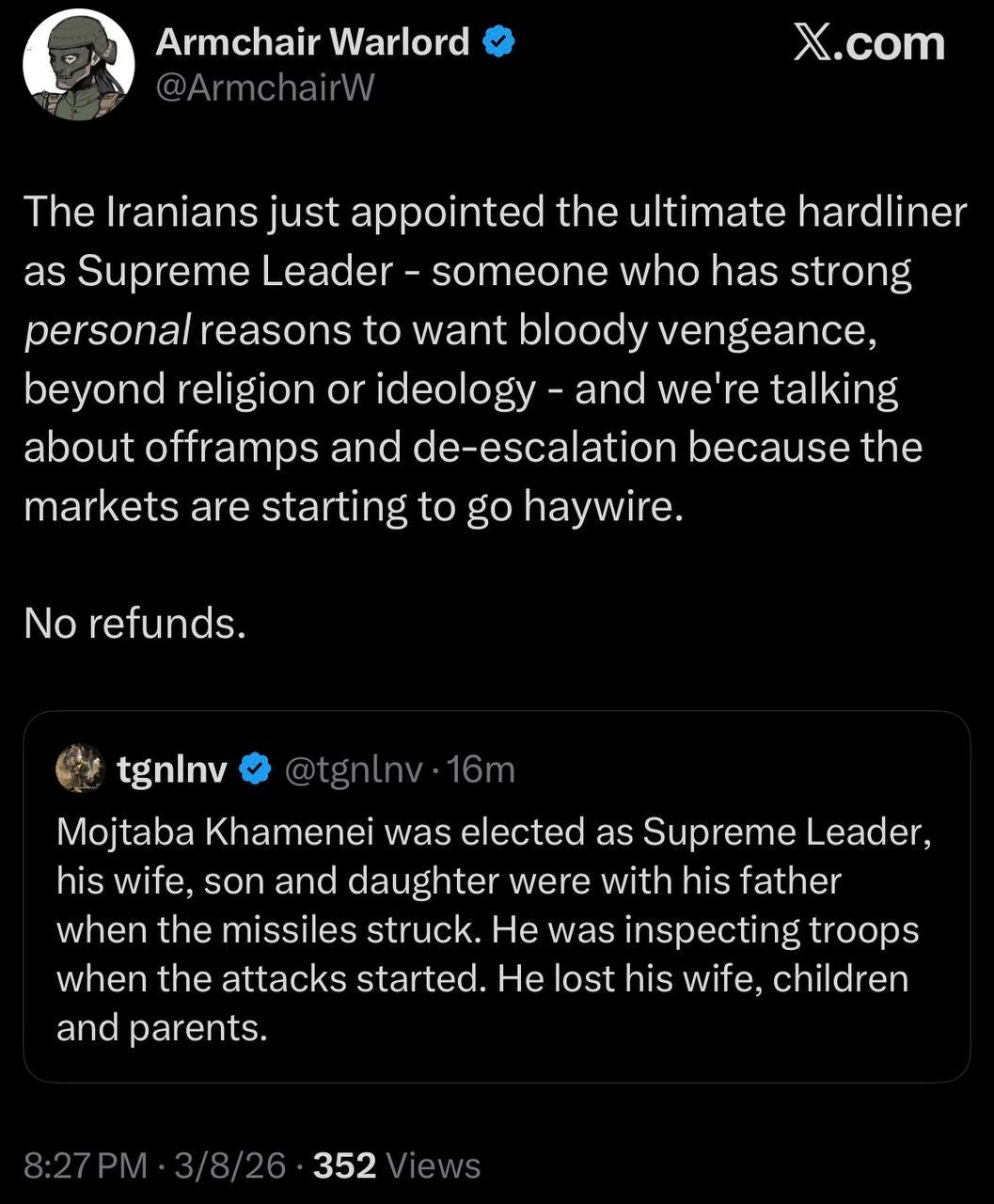
The new Supreme Leader of Iran now occupies that Oedipal position with an intensity Freud never imagined. His father’s cap was not merely knocked into the mud. His father’s, mother’s, wife’s, son’s and daughter’s bodies were torn apart by American and Israeli missiles as Iranian elite naively discussed American peace proposals. Vengeance is not now a choice. It is the new Ayatollah’s filial and fatherly destiny.
But there is another more nuanced inheritance. The elder Khamenei’s death has bequeathed to his son a geopolitical unicorn: Iran now commands the strongest position it has ever held in its war against Israel and the United States. Operation Epic Fail Fury may turn out to be the greatest strategic miscalculation in centuries. The father’s death has united Iranians far tighter than his internal security forces ever could. The Russians and Chinese, held at arm’s length for more than a decade by the old mullahs’ caution, were finally welcomed as partners after last year’s Twelve-Day War. The result is visible across the Gulf: American radar and air defense systems obliterated with laser precision, the great American hegemon now staggers half-blind in a region it once ruled without question.
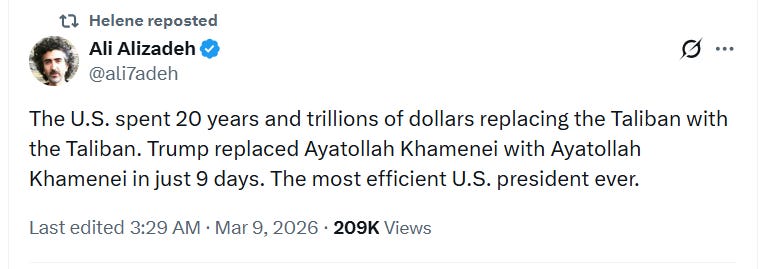
Best of all for the new Ayatollah, Iran has succeeded in “gating” the Strait of Hormuz. American officials insist, correctly, that the strait is not totally closed. Yes, indeed, a few Chinese and Iranian tankers are allowed to exit. But oil prices have soared past one hundred dollars a barrel. Trump may fear the Israeli lobby, but once the financial oligarchs—BlackRock’s Larry Fink and his peers—begin pounding the table demanding an end to this war, Trump will find himself in a sticky situation.
With US naval assets prudently keeping a thousand-kilometer distance from Iranian drone and missile launches, with American bases throughout the region in tatters, there is no military solution to releasing the commodity flows from their the penitentiary that is the Persian Gulf. Capitalism despises barriers. An important portion of global trade now stagnates in a watery prison, behind the bars of Iranian power, and the Ayatollah is the new warden in town.
Bombing to Lose
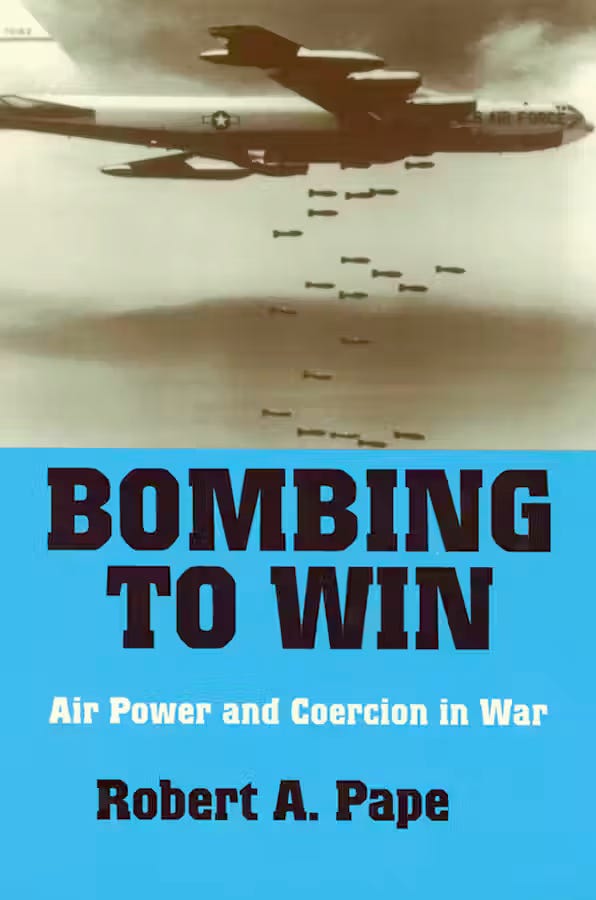
A quarter century after its publication, Robert Pape’s Bombing to Win remains the most systematic study of what airpower can and cannot achieve. Examining every major strategic bombing campaign from World War II through the Gulf War, Pape reached a conclusion that should haunt every planner who greenlit the strikes against Tehran: airpower is no magic bullet. Strategic bombing has never coerced an enemy regime into capitulation. Denial can work, but only when airpower is integrated with ground forces capable of imposing political control on the battlefield. Decapitation strikes, however satisfying in the moment, do not break regimes. They redistribute authority under conditions of emotional mobilization. The target dies. The cause metastasizes.
The new Supreme Leader of Iran now embodies that metastasis with a clarity Pape’s case studies could only approximate. History shows that when leaders are killed at the start of conflicts, their successors often escalate to prove authority—a pattern Pape calls the “Harder Successor Problem.” Leadership assassination does not simply remove authority; it redistributes it under emotional mobilization. The successor inherits a political problem: they must prove they are strong enough to rule. Backing down early can look like weakness inside the regime and to rivals watching closely. New leaders especially face pressure from military elites, revolutionary factions, and rivals inside the regime, all watching to see if the successor is strong or weak. Early escalation becomes a tool to secure authority. This is why leadership decapitation at the start of wars often fails to shorten conflicts. Instead it can lock both sides into longer, more dangerous escalation cycles.
Pape points to the 1996 Russian killing of Chechen leader Dzhokhar Dudayev as instructive: the strike succeeded tactically but triggered greater nationalism and violence that fuelled years of bloody war. Power shifted toward commanders less constrained by negotiation, and the emotional intensity widened. The pattern recurs: martyrdom transfers legitimacy. The successor must demonstrate resolve, not flexibility. The political market rewards maximalist positions. Moderation becomes disloyalty. The Americans and Israelis killed the father. They have now empowered a son whose every incentive points toward proving himself harder, crueller, more absolute than the man who died.
Symbolic Castration
The material losses from this war to the US are staggering enough. The first week of the war cost the United States roughly $6 billion, with $4 billion of that total consumed by munitions and advanced interceptors designed to shoot down Iranian missiles
Four THAAD radars are confirmed destroyed at sites across the region, each costing half a billion dollars and requiring years to replace. The AN/FPS-132 radar at Al Udeid, valued at $1.1 billion, struck and damaged on opening day. Nearly $2 billion in destroyed equipment, and that is just the hardware.
The calculus only grows more punishing when one considers what it takes to rebuild. The AN/TPY-2 radar at the heart of the THAAD system relies on advanced Gallium Nitride semiconductors for its superior detection capabilities. China controls 98 percent of global gallium production and has imposed export controls that restrict American access to this critical material. The same nation tracking every US naval movement in the Gulf, the same nation feeding real-time targeting data to Iranian commanders, holds the keys to rebuilding the very radar systems now lying in charred ruins across the Middle East. Five years to rebuild, the experts say. That assumes the materials are available. That assumes China is willing to sell. That assumes a great deal—beginning with the assumption that China has any interest in restoring the very power it is now helping Iran dismantle.
But these figures, however staggering, measure only the material. The greater loss is psychological. American bases across the Middle East have been pounded in a manner not seen since Pearl Harbor--fourteen installations targeted in the first week, six confirmed destroyed by satellite imagery, with Iranian officials claiming some will take at least five years to rebuild . The US Navy has withdrawn all vessels from its Fifth Fleet headquarters in Bahrain, pulling back to the Indian Ocean, where the USS Abraham Lincoln now lurks a thousand kilometres from Iranian shores. Ground troop invasions are impossible given the sheer scale of Iran’s ninety million people not to mention its mountainous geography. Special forces raids remain highly risky and strategically negligible. The empire that once projected power into every corner of the globe now dares not approach the Iranian coastline.
This is where the phallus concept of French psychoanalyst Jacques Lacan steps in. For Lacan, the phallus is not the organ but the signifier of power, the semblance that organizes the symbolic order, the image of invincibility that sustains authority. It is not enough to be powerful; one must be seen as powerful. The phallus must be exhibited, performed, believed. It is Secretary of “War” Pete Hegseth’s job to brandish the phallus in each and every speech or interview he gives. American power in the Middle East was always such a performance—the aircraft carriers, the stealth bombers, the THAAD batteries, the rhetoric of full-spectrum dominance. Each element signified invulnerability. Each element contributed to the aura.
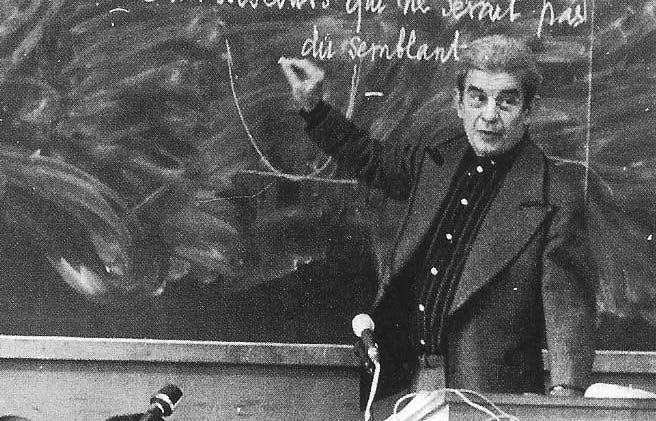
Despite Trump and Hegseth’s rock hard word salads and gaslit flourishes, Iran has systematically destroyed that American phallic aura. US radars are obliterated. The US fleet has fled. The bases burn. The interceptors are soon depleted. The American phallus has been neutered, and what remains is not power but its absence--the lack that was always there but carefully masked. Iran has not only symbolically castrated the image of American invincibility, but their barrage of ballistic missiles is creating an aura of their own phallus symbol. The war is not only military but on a higher plane psychoanalytic: the revelation that the emperor had no armour against the challenger’s cluster ballistics. The material losses can be tallied in billions. The symbolic loss is beyond calculation.
For Whom the TACO Bell Tolls
The tale of the Tar-Baby, drawn from African-American folklore and popularized in the nineteenth-century Uncle Remus stories, tells of Br'er Rabbit who, enraged by a silent tar figure he mistakes for a snubbing stranger, strikes it—only to become stuck, limb by limb, in the sticky trap. The more he struggles, the deeper he is caught.
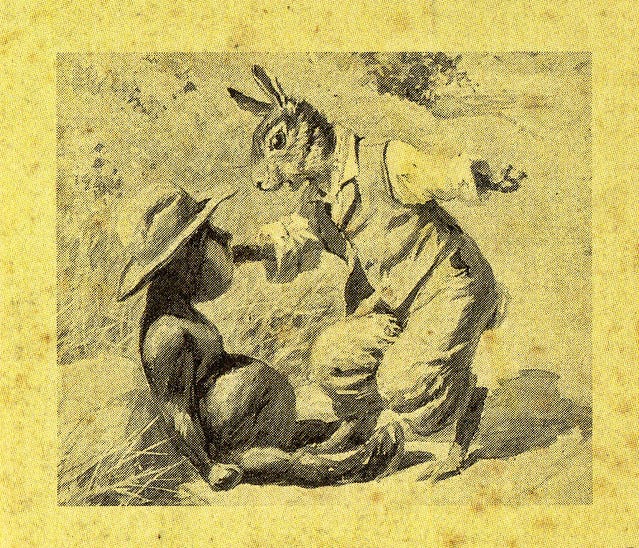
The story has long served as a metaphor for entrapment: a situation that tempts retaliation but punishes it with irreversible commitment. In military terms, this is a pinning-down operation—where one party lures another into a fight it cannot easily escape.
The key to this conflict is the Iranian closure of the Strait of Hormuz. Currently the United States has no military or other means to reopen commodity flows through this critical chokepoint. Trump will come under mounting pressure to toll the TACO bell. With talk of instituting a military draft, not to mention the coming tsunami of inflation, his domestic political situation will soon turn critical.
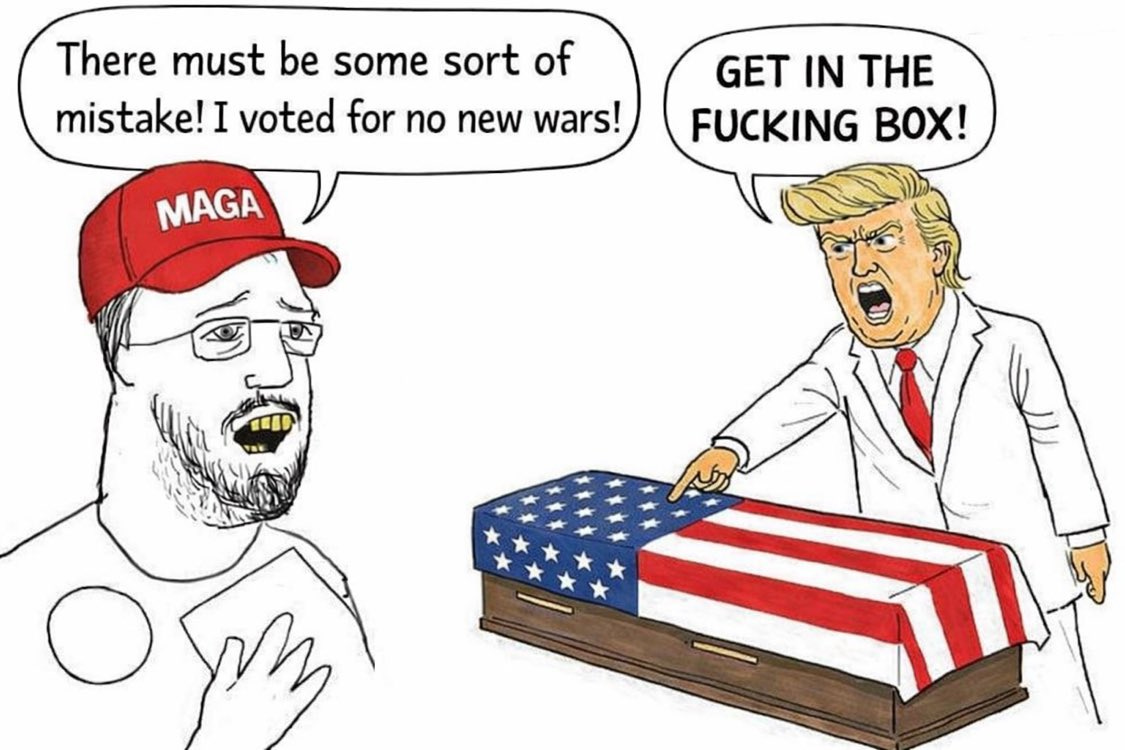
But there are no unilateral timeouts in war. The more Trump engages with Iran, the more he gets pulled into the Tar-Baby quagmire. It is not enough for Trump to cut and run, to call off military strikes—there is no guarantee that the new Ayatollah will reopen the strait, certain in the knowledge that the Grimmer Twins of Trump and Netanyahu will launch an even more massive attack six months down the road.
So the Twelve-Day War model of a white peace, where everything returns to the status quo ante bellum, is highly unlikely now. Most of eastern Iran remains untouched by American and Israeli bombs. Iran is more than capable of keeping the strait closed indefinitely. Russia and China see this war as a colossal blunder by Trump and will push Iran to extract maximum concessions in return for peace.
As of today, the only road to an American / Israeli victory runs through fantasy: perhaps the new Ayatollah will tomorrow rip off his hardliner mask, out himself as a Mossad asset, and order his military to surrender before the awesome specter of American and Israeli might? Never say never, but let’s agree this is a longshot.
And so the discussion will inevitably turn towards Iran's terms for peace. A complete American withdrawal from Persian Gulf military bases? The cancellation of all US sanctions? Perhaps the new Ayatollah, taking a cue from Europe's demands on Putin, will insist on massive war reparations, war crime trials for Trump and Netanyahu, or maybe just settle for a formal apology? Here is where the new Ayatollah might seek council from his father’s more moderate ways.
What Iran/Hezbollah will demand from Israel remains unimaginable. Iran cannot end the war until Hezbollah is given protection in the final deal.
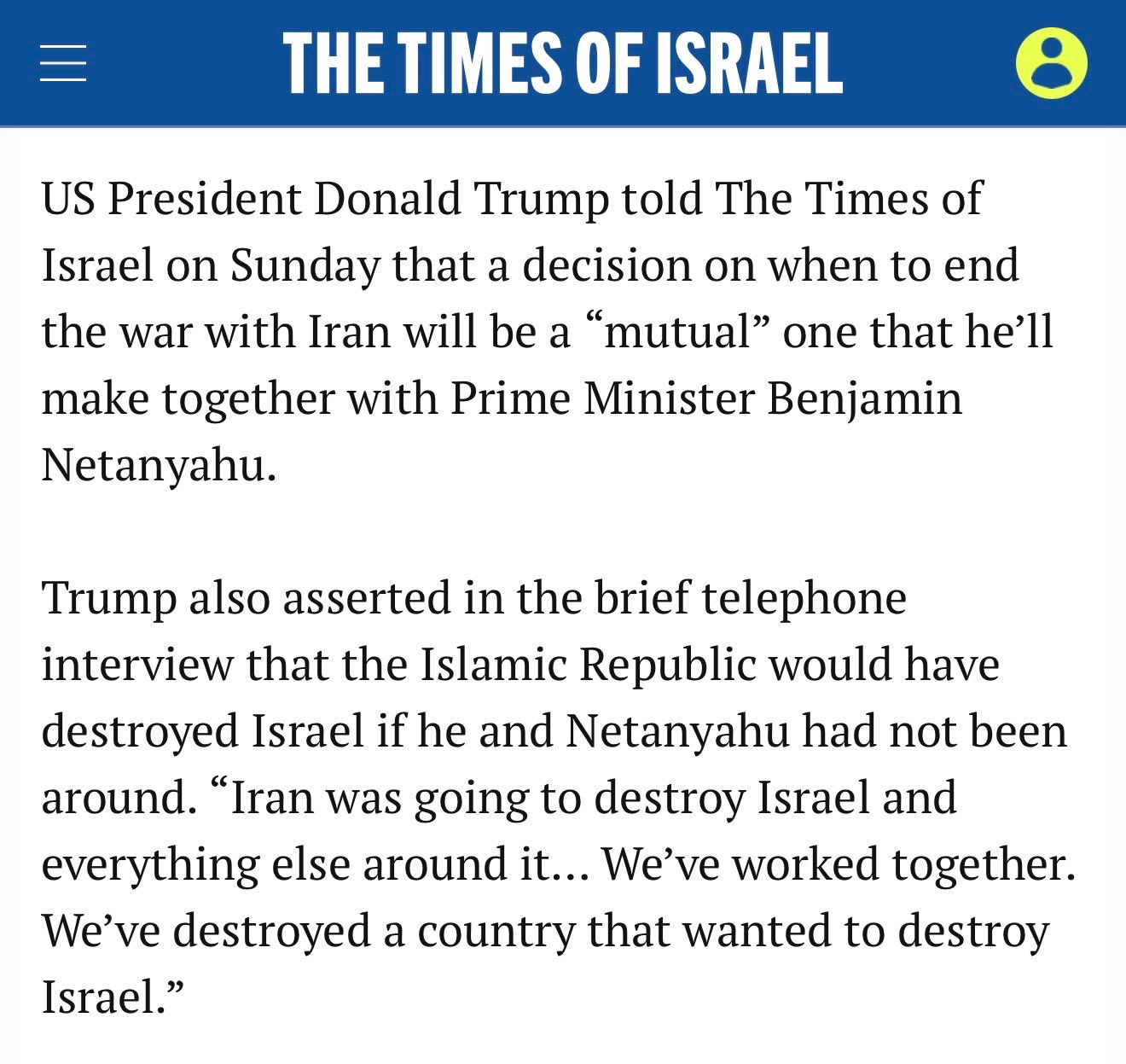
Thus the United States finds itself in an unprecedented position. Trump has promised to decide with Netanyahu when the war ends. What he didn’t realize was that this will be a group decision--including a new Ayatollah along with China and Russia. The more the US struggles with Iran, the deeper they sink in the quagmire. No one can deny that Trump is a master alchemist of narrative victory, he can remould the reality of any disaster and make it the greatest triumph, perhaps ever, in human history. Be that as it may, at this point, Iran has the final say as to when Trump gets to toll the TACO bell.
Another excellent essay Kevin, I fully agree with your conclusions. I love how you mix the psychological elements with the geopolitical one.
* It seems that "Khamenei fils" has already issued a fatwa against nuclear weapon like his dad. So that would not make him more ruthless. But still, I agree he may probably be more ruthless for the reasons you mention and as well because it seems that "Khamenei père" was a bit out of touch with the reality of US power. (Examples : his faith in negotiations with the "Great Satan" seems a complete contradiction, for as Faust knew, you should avoid dealing with the devil. And then enriching U235 to 60%, seem mistakes in hindsight.)
* Yes, the phallus symbol is significant, but it seems the US does too much of (pea)cocking. Sometimes, just hinting implicitly at the potentially lurking snake, like the Russians do, is sometimes more powerful and suggestive. When Trump and Hegseth keep reminding everybody of how what an enormous phallus they have, it somehow strains belief (small hands!) and introduces an element of doubt about their actual prowess.
* This phallus comment combined with the efforts made with the tar figure together remind me of Doctor Strangelove, where the General retains his "precious bodily fluids" ; namely a sated man who has given it all to a woman, who is therefore unable to show his phallus (erect of course), is a bit less of a man; less powerful and less motivated.
1. The United States goal in Iran is to turn that country into a failed state, as was done to Iraq, Syria and Libya.
2. MAGA is, first and foremost, a cult of personality. Whatever Trump does, they are for. Until Trump is against it. Then they are against it