
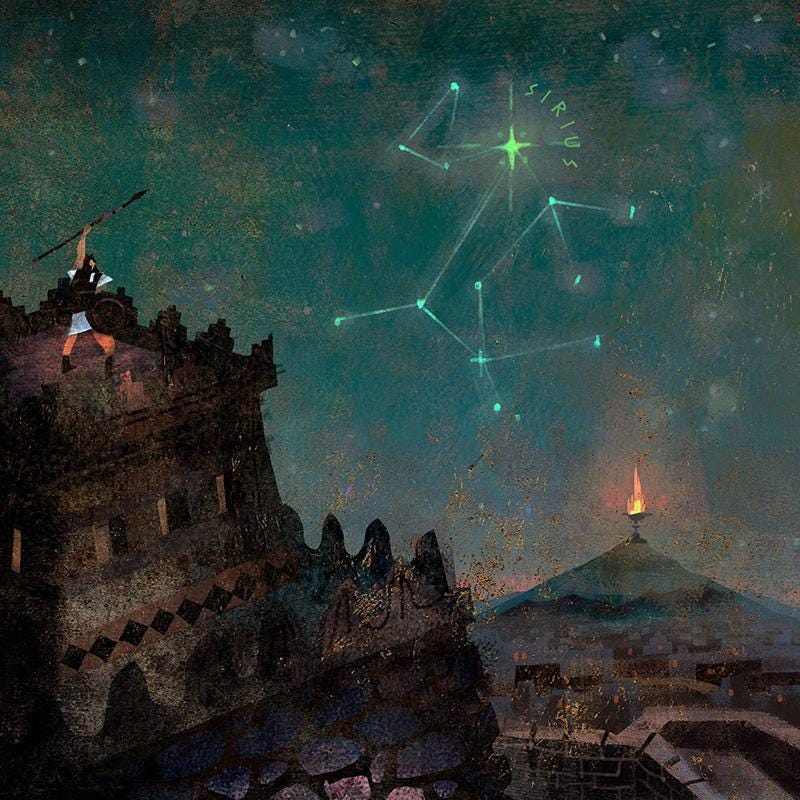
“I beg the gods to give me release from this misery—from my long year of watch-keeping.”
With these words, Aeschylus opens his monumental fifth-century BC tragic trilogy, the Oresteia. Aeschylus famously remarked that his sweeping dramas were merely “slices from the great banquet of Homer.” The trilogy—Agamemnon, The Libation Bearers, and The Eumenides—picks up the mythological threads of the Trojan War to express timeless psychological truths.
Perched high upon the palace roof at Argos, a lone watchman strains his eyes through the dark, waiting for a distant beacon fire to signal that King Agamemnon has finally conquered Troy and will soon return home. While the watchman’s physical gaze searches the dark for the returning patriarch, his inner world is consumed by a present misery whose deepest roots lie in the past. Hypervigilance consumes him, his sleepless gaze fixated on the far horizon while the palace rots beneath his feet. His agony includes the dull, grinding ache of boredom—the soul-crushing monotony of scanning the same empty prospect, night after numbing night, craving a vindication that never seems to arrive.
Over the centuries, this night-watchman has transformed into an archetype for anyone trapped in the exhausting cycle of rumination. To hold a deep grievance is to act as this watchman: frozen in a painful, defensive posture, wet with the dew of one’s own sweat and tears, and enduring the unbearable boredom of mentally rehearsing the same old story while fanning the hidden embers of smouldering injuries.
In the mythic world of the Oresteia, these embers are constantly stoked by a lineage of violence, where every past injury demands a future payment in spilled blood. The tragedy of the watchman’s house is that the beacon fire he prays for—the very object of his hope—will not bring him a happy release. Instead, it will deliver the king home to an ambush, transforming the watchman’s longed-for relief into the opening act of a far greater catastrophe.
Alongside Aeschylus’s masterpiece, the psychological framework of Fred Luskin’s Forgive for Good offers a powerful lens. Luskin defines forgiveness as the conscious act of releasing our grip on past injuries and ceasing to demand that history rewrite itself for our comfort.
This ancient dynamic also provides a framework for understanding the modern geopolitical landscape—though the watchman archetype is not evenly distributed. The United States and Iran strategically deploy grievances to justify imperial expansion or consolidate domestic control.
But the nation that truly inhabits the watchman’s sleepless vigil is Israel, whose identity is rooted in a living historical catalogue of trauma: the Holocaust, the Dreyfus Affair, the Russian pogroms, expulsions from over a hundred nations, centuries of blood libels, the Roman destruction of the Second Temple, the Babylonian Exile, the Assyrian Exile—a litany of historical grievances spanning three millennia.
For Israel, the past is both a psychological prison and the enduring source of Jewish identity—a people who have survived antiquity into the present day by maintaining internal cohesion through a perpetual state of hypervigilance against the external other. This existential posture renders any concept of diplomatic mutuality a potential act of treason against the very memory that defines them.
This fusion of a permanent trauma narrative with the mechanisms of a nuclear-armed state represents the ultimate test of Luskin’s framework. Together, these perspectives reveal how international conflicts mirror personal wounds. Ultimately, if grievance is the act of fanning destructive embers and spilling blood, then the principles of forgiveness offer a systematic path to let the fires safely fade away, replacing a legacy of carnage on the battlefield with the vital, life-giving pulse of a peaceful future
The Oresteia: Ancient Grievance
To see how an unprocessed wound scales from the individual psyche to collective instability, the Oresteia offers a foundational model. Long before clinical language formalized the "grievance story," this trilogy mapped a system driven by unresolved injury, where past violence persists as a volatile ember smouldering beneath the surface of every action. The entire mythic framework can be read as a Janus-faced interplay of blood and embers - forces that carry both the destructive residue of the past and the hidden potential for life-giving renewal.
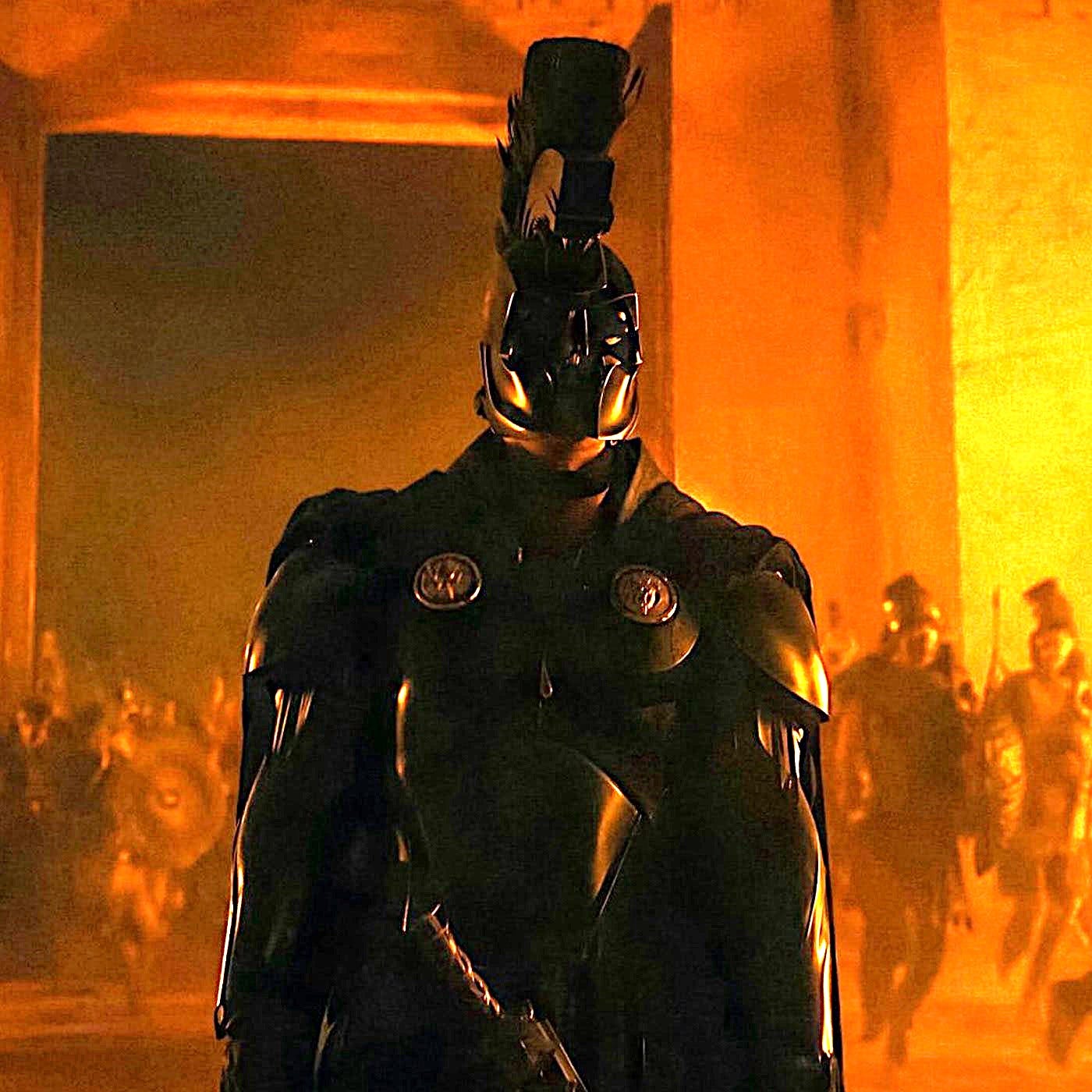
A blood feud reignites with an outrage that drives the subsequent drama: the horrific sacrifice of an innocent child. To launch his fleet to Troy, King Agamemnon slaughters his own daughter, Iphigenia, treating her life as a transactional cost for geopolitical ambition. When he returns victorious, he expects the debt to be settled, the wound to have healed. But for his wife, Clytemnestra - joined by Aegisthus, heir to the very blood-feud Agamemnon's father had set in motion - the murder of her child is a live ember burning fiercely in her chest. Her grief, fanned by betrayal, refuses to let the ashes settle. To quench her own internal fire, she gashes his throat in his bath. Yet, far from extinguishing the flames, this ‘decapitation’ strike merely pours fresh blood onto the fire. In this tragic landscape, spilled blood congeals into glowing embers, ensuring that the loop of vengeance will inevitably demand a fresh sacrifice.
In The Libation Bearers, this burden falls upon their son, Orestes. Under the divine command of Apollo, he returns to the ruined house to murder his own mother, translating a received family grievance into a new physical rupture. By shedding maternal blood, Orestes unleashes the most terrifying manifestations of unresolved injury: the Furies. These three monstrous sisters - Alecto (endless anger), Megaera (grudging), and Tisiphone (avenger of murder) - are the physical embodiments of unyielding grievance. They orient entirely toward past wrongs, blind to context or future consequences. In psychological terms, the three sisters resemble a mind locked in recursive, manic activation, perpetually fanning the embers of an old wound, hunting the perpetrator with a relentless, consuming bloodlust.
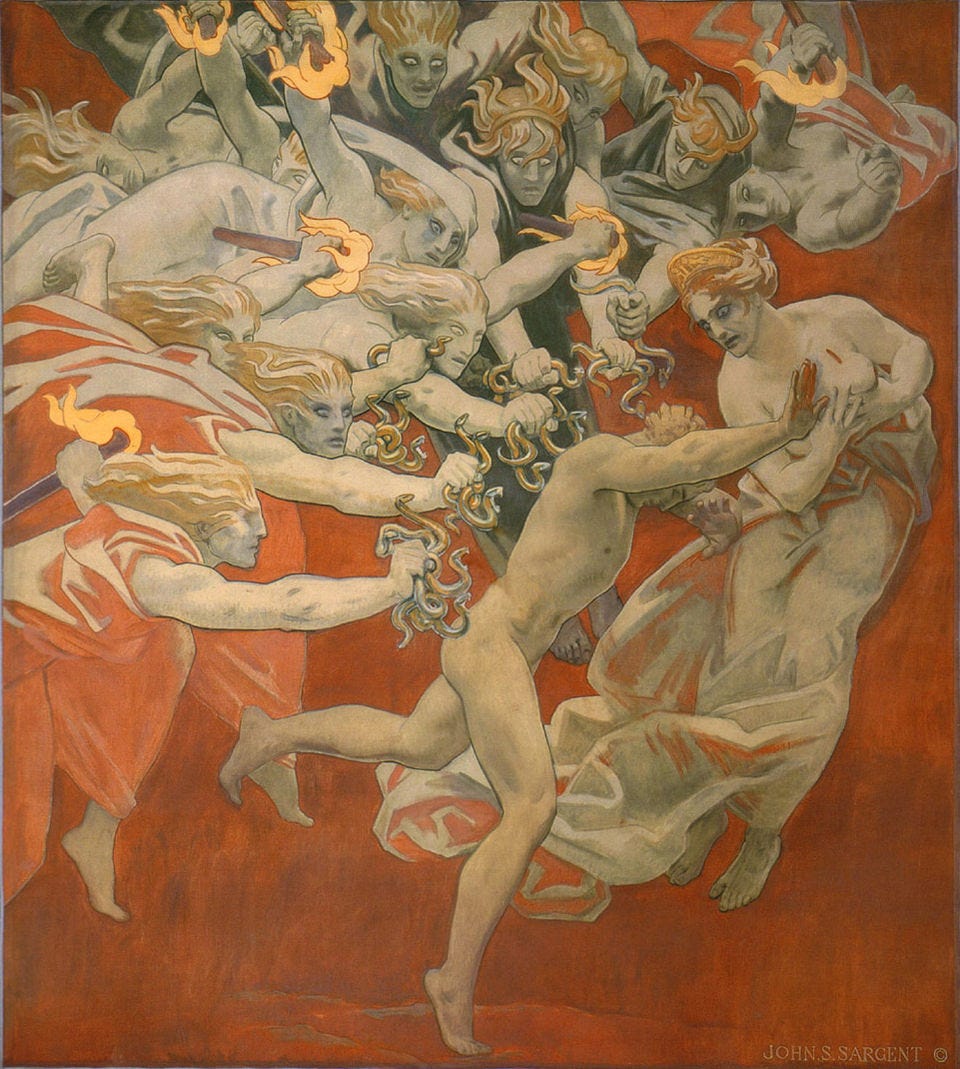
Importantly, Aeschylus frames this cycle as a profound cosmological clash: the sky-dwelling Olympians against the old chthonic deities of the underworld. The Furies, born from the blood of Uranus and rooted in the earth, represent an archaic, matriarchal moral order, where primal blood-ties are absolute and any violation must be answered with immediate, literal blood.
Apollo and the newer gods, enthroned on Olympus, represent a rising, paternalistic structure that values civic order, contract, and abstract authority. The trilogy is set within this cosmic interregnum - a chaotic threshold where an old world order is dying and a new one is struggling to be born. In this painful transition, the unending cycle of violence becomes the morbid symptom: blood that should nourish the community is instead spilled uselessly, staining both the battlefield and the palace floors.
Resolution only arrives in The Eumenides when Athena intervenes, establishing the Areopagus—a formal court of law. This structural shift is one of containment and alchemy, transforming the Furies' fire into a civic guardian. Rather than destroying the three sisters, Athena offers them a designated chamber beneath the city, renaming them the Eumenides, or "The Kindly Ones." In this containment, their raging fire is now safely domesticated; their energy is harnessed to protect the city rather than consume it. Blood ceases to be spilt for private vengeance and is instead kept warm as the quiet, vital current of a living society.
Forgiving Without Forgetting
The Oresteia stages a prolonged struggle over inherited injury, where acts of violence circulate across generations and demand resolution. What appears in tragic form as an external cycle of vengeance persists in the modern day as internal turmoil. Long after the ancient blood feuds have exited the stage, we continue to host them within our own psyches, carrying forward grievances that demand constant vigilance. When this internal friction intensifies at the interpersonal scale, the clinical psychology outlined in Fred Luskin's Forgive for Good offers a precise, self-directed model of stabilization.
Stripping away moral obligations and altruistic platitudes, Luskin frames forgiveness as a pragmatic intervention in the subject's own nervous system—a method for clearing accumulated psychic residue, allowing the heat of an old wound or grudge to finally subside and cool.

At the centre of this protocol lies the dismantling of what Luskin calls the "grievance story." This narrative structure operates like the Three Furies, trapping the mind in a relentless, backward-facing vigil. The grievance story takes a past trauma and rehearses it continuously, keeping its embers red-hot and active across time. In this state of perpetual agitation, the mind behaves like an unhealed body, sending all its energy to defend an open, weeping wound. Luskin's protocol introduces a controlled psychological reorientation: the subject acknowledges the painful event as fixed and unalterable, then consciously withdraws the demand that the past must dictate the present.
This structural move breaks the cycle of the blood-feud. It shifts the individual's narrative framework from the passive, helpless misery of the watchman to a position of heroic personal agency. In the gripping loop of a grievance story, the old embers are constantly fanned, and a deep-seated bloodlust demands more spilled blood to settle an unquenchable debt. Forgiveness allows those embers to cool into quiet guidance, safely contained within the architecture of memory. Stripped of its destructive compulsion, blood is no longer poured out as an offering to old ghosts; instead, it is returned to its rightful place as the vital, life-giving current that allows a person to step down from the roof, close their weary eyes, and move forward into the future.
Fleetwood Mac: Grievance and Grace
The deep-seated tension between the fanned embers of grievance and the life-giving vitality of forward orientation extends far beyond the amphitheatres of ancient Greece and the sterile offices of modern clinical psychology. To demonstrate the enduring, universal nature of these archetypes, one can look from the tragic stage to the Sausalito recording studio of twentieth-century popular music. The fierce interpersonal ruptures within the popular band Fleetwood Mac created a public stage where the same psychological structures played out in real time. Through their contrasting song-writing styles, Stevie Nicks and Christine McVie embody two timeless, divergent responses to emotional injury: one holds a wound as a destructive fire, the other releases it into a current of renewal.

In the music of Stevie Nicks, the grievance story sustains its brilliant, scorching heat. Her masterpiece "Silver Springs" - written after her painful romantic rupture with bandmate Lindsey Buckingham - serves as a musical cage of hyper-vigilance, where the embers of betrayal are deliberately kept red-hot. Nicks binds her voice to memory, fiercely singing to her former lover:
“Time casts its spell on you, but you won’t forget me / I know I could have loved you, but you would not let me / I’ll follow you down ‘til the sound of my voice will haunt you.”
This is the vow of a modern-day Fury, a refusal to let the blood of an old relationship dry. By promising to haunt the perpetrator, Nicks ensures the past remains in perpetual circulation. The wound is never allowed to heal; its embers are continually stirred, preserving her personal identity through an eternal and defiant closeness to her injury.
Christine McVie, writing amid the exact same period of marital collapse and collective heartbreak, offers a radically different temporal movement. In “Don’t Stop,” she refuses to fan the embers or demand vengeance, instead consciously releasing the past’s grip on her nervous system. She sings:
“Don’t stop thinking about tomorrow / Don’t stop, it’ll soon be here / It’ll be better than before / Yesterday’s gone, yesterday’s gone.”
McVie’s lyrics perform the exact alchemical shift prescribed by modern forgiveness protocols. By declaring that yesterday is gone, she clears a space for continuation, allowing the residual emotional heat of divorce to settle into quiet ash. She chooses to let her energy flow forward, refusing to pour more blood on the battlefield of mutual recrimination.
These two distinct artistic orientations illuminate the enduring ways human beings respond to rupture. One sustains the fire of grievance as a living, consuming force; the other lets the embers cool into wisdom that can be carried without combustion. Across ancient tragedy, modern psychology, and contemporary song, the same fundamental question persists: how to live with an injury without letting it set the present ablaze.
Fanning the Embers on the Grand Chessboard
The conceptual leap from the individual psyche to the chessboard of international relations is less radical than it might seem. The mechanics of grievance at the individual level find a striking parallel in the behaviour of states. In both domains, the ruling entity - whether the dominant partner in a dysfunctional relationship or the ruling elite managing a population - strategically cultivates a narrative of past grievances to maintain control. For the state, the grievance narrative becomes a highly rationalized instrument of political survival. By fanning the embers of external hostility, state managers seek to manufacture domestic cohesion and deflect internal crises outward.
This geopolitical architecture operates through a parallel structural logic on both sides. In Washington, the political establishment routinely invokes Tehran's history of hostility toward American interests, often omitting that many of these conflicts involve military personnel deployed in the region. Reciprocally, the state apparatus in Tehran strategically invokes the 1953 coup and decades of crippling Western sanctions to mobilize a permanent narrative of resistance. Both elites engage in what Luskin would recognize as a toxic grievance story: they cultivate a state of perpetual psychological and ideological activation, ensuring that the state's legitimacy becomes closely tied to the perpetuation of the feud. If an individual fans embers out of psychological compulsion, a ruling class fans them to justify military mobilization and secure domestic rule
Regression into the Blood Feud: Operation Epic Fury
The catastrophic escalation of this conflict crystallized in the launch of the American-Israeli military campaign aptly titled Operation Epic Fury. While both sides had long cultivated grievance narratives, it was the American-Israeli coalition that broke the tense, armed equilibrium with this pre-emptive strike. Beginning with a surprise decapitation strike that killed multiple senior Iranian commanders, officials not to mention their Supreme Leader and much of his family, this operation marks the definitive regression of great-power statecraft into the archaic logic of the blood feud.
Where Athena sought the calm containment of passions, this campaign represents an instantiation of the Furies themselves. By unleashing this onslaught, America unleashes a toxic grievance narrative scaled to the dimensions of empire, driven by a desperate, short-sighted calculus. The vital fluid of state sovereignty and human potential - which prudent statecraft seeks to keep contained within the stable vessels of institutional treaties - is violently spilled across the region, exhausting the material and moral reserves of the old order.
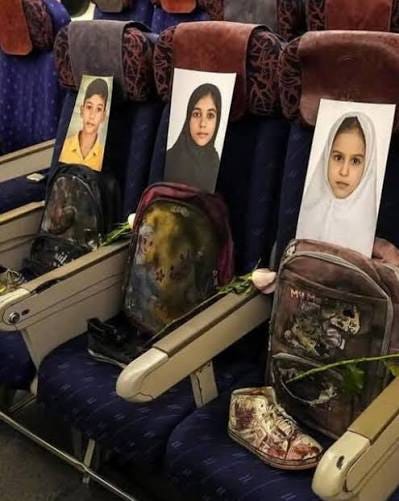
This grim entrapment found its most devastating realization in the missile strike that destroyed the Shajareh Tayyebeh Elementary School in Minab, killing over a hundred and sixty innocent schoolgirls. While US officials attributed the tragic strike to an AI targeting error, the effect was uncannily strategic: the sacrifice of innocent children, like Iphigenia, to cement a martial blood bond between the US and Israel while psychologically locking Iran into a forever war. Whether by design or the brutal carelessness of modern warfare, the resulting grievance narrative was too visceral to ignore - a wound that all but guaranteed the conflict’s recursive escalation.
Multipolar Areopagus: A Framework for Peace
It is precisely within the vacuum left by the old order's exhaustion that a new diplomatic architecture has stepped forward, assuming the mantle of a contemporary Athena. Where the original Areopagus - the court established by Athena in The Eumenides - offered a formal legal container to transform the Furies' destructive fire into civic guardianship, this modern counterpart offers a diplomatic and economic container for transforming regional antagonisms into cooperative co-existence. Recent diplomatic manoeuvres - most notably the brokering of the Saudi-Iranian rapprochement and the subsequent incorporation of regional powers into the expanding BRICS alignment - operate on a logic of cool, mercantile pragmatism. This growing configuration functions as the modern geopolitical instantiation of the Eumenides. The multipolar framework offers, in place of ideological conversion, an institutional temple where states previously defined by intense mutual hostility are integrated into a stable structure of economic co-existence.

Under this multipolar umbrella, the smouldering embers of ideological warfare are starved of the oxygen of exclusionary alliances. The visceral impulses of regional rivalry are contained, subsumed by the shared imperatives of infrastructural development and sovereign insulation from Western financial leverage. By giving these historical adversaries a material stake in a cooperative global architecture, this project achieves on a macro-scale what the individual must accomplish within Luskin's therapeutic framework: it strips the past grievance of its power to destroy the present. The Furies of regional trauma, long driven by the historical injuries of colonialism and great-power intervention, are systematically transformed into the guardians of a cooperative, life-giving peace.
Intractable Sanctuary or Final Peace?
The analytical path toward a polycentric peace arrives at its most difficult challenge when confronted with the structural ideology of the Israeli state. If Fred Luskin's therapeutic framework demands the dismantling of the grievance narrative, Israel presents a condition where that narrative forms the foundational tissue of the political culture itself. The state frequently invokes Amalek - the biblical archetype of absolute, unquenchable malice - to frame contemporary geopolitical adversaries like Iran. This invocation transforms a complex modern territorial dispute into an ahistorical, metaphysical struggle for survival. By casting the adversary in these absolute, theological terms, the state renders any concept of diplomatic mutuality or Luskin's "enforceable hopes" an act of existential treason. The grievance story is fanned to the point of institutionalization.
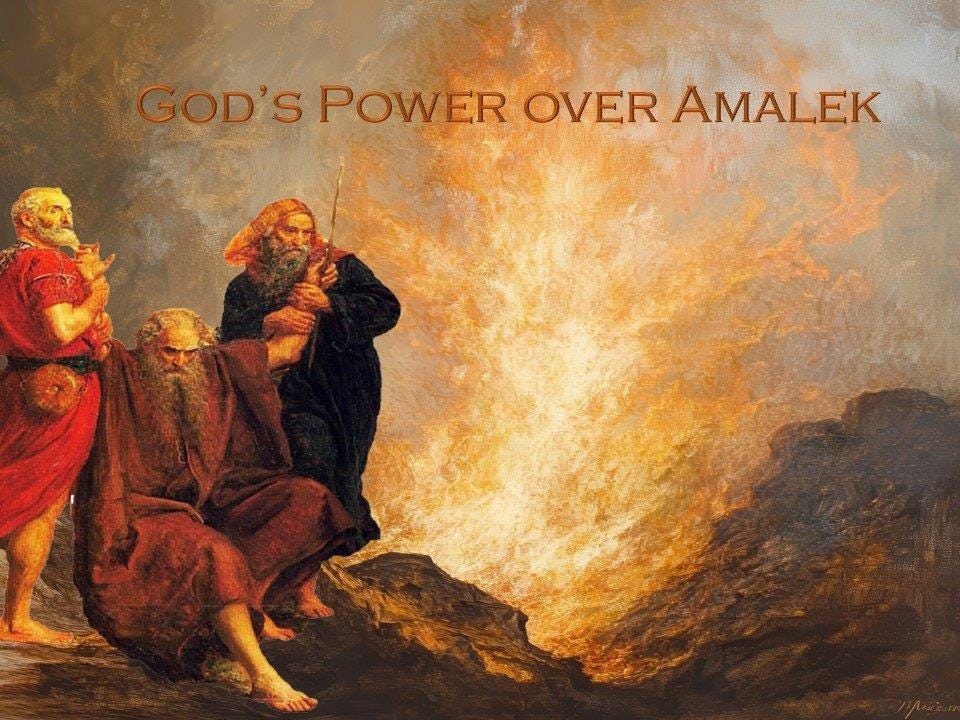
This fusion of a permanent trauma narrative with the mechanisms of a nuclear-armed state has structurally altered global statecraft. Through the formidable leverage of its domestic lobby, Tel Aviv has successfully bound the American state apparatus to its own strategic anxieties. Washington is effectively precluded from relinquishing its own grievances toward Iran; any attempt to transition toward an Athenic model of regional coexistence is immediately checked by a client state demanding total ideological alignment. The United States remains tethered to a perpetual trauma machine, forced to externalize these existential anxieties as global military policy, ensuring that the embers of the Levant are continuously fanned to illuminate an imperial frontier.
A slender filament of hope persists, however, within this grim alignment. Athena's triumph over the Furies came through their encirclement by a larger, more compelling reality, not from converting the irrational within them. As the Chinese-led multipolar architecture continues to consolidate through BRICS, the effective veto power of the U.S.-Israeli axis faces structural obsolescence. The cooling of the wider region - the systematic integration of its neighbours into structures of economic vitality - creates a geopolitical containment field. Israel and its imperial patron may choose to retain the comfort of their eternal grievances, but a polycentric world order, insulated from Western financial leverage, possesses the capacity to render those grievances functionally impotent, forcing the old gods of retribution to rage in an ever diminishing domain.
Peace, in this tragic dialectic, requires not the erasing of memory but the relocation of its fires. It demands the statecraft that Aeschylus celebrated at the close of his trilogy, where the traumatized Furies of the past are finally escorted by torchlight into the deep, foundational recesses of the civic architecture. Only when blood is kept where it belongs—nourishing the internal vitality of the community instead of staining the regional soil—can the cycle of repetition dissolve and allow the weary watchman to finally step down from the roof. The hope for the international order lies in the patient, material construction of a world where the ancient fires are finally capped, and the torches are carried downward into the sanctuary, leaving the earth above to heal.
As the citizens of Athens sang to lead the Furies to their rest: “Go on your way, great and jealous spirits... under the flame of the torches that lead you below the earth. Let the fire keep its peace.”
This was a rare article that did not resonate with me… the issue with Washington is not “misunderstanding”, it’s that the intended victim knows perfectly well what Washington desires… recall the conversation between McNamara and the Vietnamese general - “I don’t believe we misunderstood you. You were the enemy. You wished to defeat us and then destroy us…”
The night watchman digital illustration is well done.